



Retail media is expected to hit $203.9 billion market size in 2026 – a 14% jump from last year, according to Coresight Research. Rockbot was proud to sponsor this organization’s report on ten major retail media trends reshaping how brands approach customer engagement.
Coined the third wave of digital advertising alongside search and social, retail media continues to evolve, especially in terms of brand strategy. These predictions can serve as a strategic roadmap for retailers looking to stay ahead of the curve, especially when it comes to retail media networks (RMN’s) and their in-store retail media approach.
Trend #1: Retail Media Networks (RMN's) Now Build Brands, Not Just Drive Sales
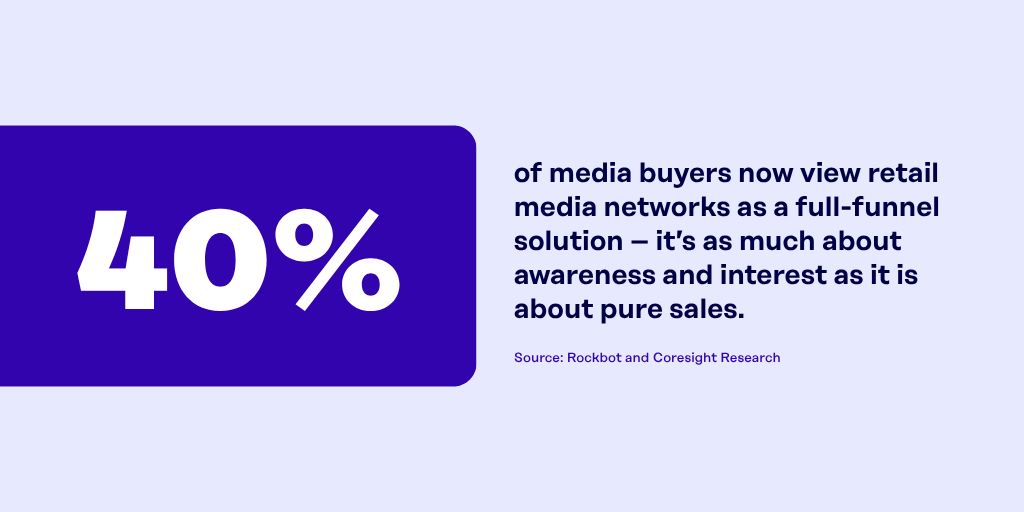
The focus for RMNs is expanding beyond last-click conversions. In fact, 40% of media buyers view retail media networks as a full-funnel solution, just shy of social media platforms (at 52%). Why is this significant? For years, retail media has been focused on the bottom of the funnel, favoring sponsored products and search digital ads.
Now retailers are using formats that engage consumers earlier – think video, audio, connected TV (CTV), and in-store displays. Modern brands can put retail media to work, influencing awareness and consideration well before purchase.
This shift is happening for a few reasons:
-
Shopper data: Retailers have purchase data that Facebook/Google don't because they know what people actually bought, not just clicked on.
-
Better measurement: As attribution models for retail media networks improve (see trend #4), brands can justify further investments in retail media.
-
Sponsored search and social fatigue: Rising costs and diminishing returns on traditional tactics like social media ad spend are inspiring businesses to explore alternatives.
-
AI-driven improvements: Automation is making it easier to plan and scale marketing campaigns across the full funnel.
-
Format expansion: With better tech options for programmatic, offsite, CTV, and in-store messaging, advertisers can more easily reach shoppers across the entire shopping journey.
In physical locations, audio messaging and digital signage represent modern customer engagement strategies that reach shoppers at the awareness and consideration stages (right when shoppers are walking the aisles deciding what to buy). Proximity is an advantage, reaching people with in-store retail media at the moment of decision with more than just price promotions.
Trend #2: In-Store Media Is Becoming the Next Big Growth Area for Retail Media Advertising
More and more, physical stores are capable of becoming digital advertising channels as the retail media market expands. Retailers that install digital screens, audio systems, and smart displays can equip brands to run programmatic advertising where shoppers are making decisions.
The data justifies this choice:
-
76% of purchases in 2026 will happen in-store
-
37% of shoppers have bought something because they saw in-store media promoting it
-
34% of consumers said they'd consider a product after hearing an in-store audio ad
-
54% of shoppers say promotions, discounts, and coupons are the most valuable type of in-store media content – and these can now be delivered through retail media networks
Why is this trend taking hold now?
-
Digital signage and audio systems have become easier to incorporate at scale
-
Retailers have better ways of measuring how in-store ads influence sales, making it easier to prove ROI
-
Today's in-store media can be dynamic and targeted (forget static posters)
Modern digital signage for grocery stores, as an example, allows brands to update messaging in real-time based on inventory levels, time of day, weather, or local events. Stores can promote seasonal items, cross-sell complementary products, highlight customer loyalty benefits, and showcase local suppliers—all while tracking how these promotions drive actual purchases.
Retailers are linking in-store media to their online advertising so brands can run unified campaigns that leverage current best practices for omnichannel customer experience. Nearly half (44%) of retail executives believe investments in in-store technology will directly boost their profit margins by 1.5 percentage points.
Trend #3: Connected TV Makes Retail Media Advertising Trackable and Performance-Driven
CTV is supporting the expansion of retail media strategy beyond e-commerce, such that brands can reach consumers via streaming platforms. Its biggest value add? Moving viewers from awareness to action. Performance-driven CTV brings the principles of digital performance marketing (ensuring campaigns are trackable, optimizable, and results-focused) to premium TV environments.
Here’s how that can work in practice:
-
Shoppable features (including QR codes, interactive overlays, and TV-to-cart) that shorten the path from discovery to purchase
-
Higher completion rates in full-screen TV environments where viewers watch long-form content
-
Advanced measurement that links CTV exposure directly to website visits and purchases
Several factors are bringing this trend to the forefront:
-
Viewer receptivity: 59% of CTV viewers find TV ads useful for shopping information (a 43% YoY increase), and 71% want ads personalized to their preferences
-
Precision targeting: CTV uses first-party and third-party data to reach specific audiences by interests/behaviors/demographics – this is an obvious departure from traditional TV's broad demographic targeting
-
Closed-loop measurement: Retailers can track CTV exposure to determine its effect on both online and in-store sales, proving value
-
Integration with retail media networks: Retailers can connect CTV ads directly to shopper data to prove which ads drove sales
A real-life example: Amazon and Roku teamed up to let advertisers reach 80 million streaming TV households through a single platform that combines both companies' streaming devices and apps. The partnership connects advertisers' messages with Amazon's shopping data to target logged-in viewers across all their devices.
To take advantage of this trend, businesses need retail media solutions for CTV that can serve brand-safe content in high-traffic physical locations. The goal here is to engage consumers as they watch premium TV content in real-world environments like gyms, retail stores, or restaurants. The right approach is unified, with TV management as a component of the brand's retail media strategy.
Trend #4: Marketplaces Give Retailers More Products to Advertise (And More Advertisers)
Online retail marketplaces (a.k.a. third-party seller platforms) are driving RMN growth. When retailers open platforms to third-party sellers, the businesses can offer more and different products, increase traffic, and attract new advertisers. In a sense, this creates a flywheel: more sellers → more products → more traffic → more ad inventory. Further, the expanded product assortment that drives more traffic attracts more ad placements and a larger advertiser base, which drives competition, and retailers can charge more to sell ad space.
Increasingly, marketplace infrastructure offers a scalable foundation for retail media networks. Technology partners (i.e., Mirakl Ads and Criteo) enable sponsored listings, display formats, and offsite activations. This opens up participation for mid- and long-tail sellers – smaller organizations with lower sales volume – who can then become advertisers.
Why now?
-
Marketplace launches are increasing: Retailers across beauty, electronics, and specialty categories are launching marketplaces to increase product assortment, traffic, and basket size
-
New advertiser segments: Marketplaces attract smaller brands and long-tail sellers who benefit from self-serve ad tools and lower entry ad spends
-
Profitable with low overhead: Participating online retailers earn money from both marketplace commissions and retail media advertising, without needing more stores or inventory.
Industry examples include Ulta's 2025 launch of UB Marketplace (using Mirakl's platform) and Best Buy's third-party marketplace, both transforming from first-party-only retail into hybrid models that create new advertising opportunities. As marketplaces grow, so does the need for credible measurement, since partners won't keep advertising budgets in place without proof that campaigns are working.
Trend #5: Evolving Standards Are Bringing Accountability to Retail Media Networks
Retail media, and retail media networks specifically, have grown faster than the industry’s ability to measure their impact. Performance gets reported inconsistently across retailers, which has become a major barrier for advertisers trying to scale their investments with confidence.
Given that, as of 2025, only 32% of marketers could measure holistically across channels, quantifying the success of retail media platforms has been challenging. And even when data is available, it may not be meaningful.
Luckily, the industry is moving toward standardization, transparency, and independent verification. In 2024, the Interactive Advertising Bureau (IAB) and the Media Rating Council (MRC) introduced foundational guidelines for retail media measurement. Since then, the market has shifted from defining standards to actively certifying networks.
Albert Heijn became the first retail media network certified under the IAB Europe Retail Media Certification Program in September 2025, covering Display and Sponsored Products. Walmart Connect followed in October 2025, receivingMRC accreditation for its Sponsored Search platform, including clicks, impressions, and click-through rate.
Third-party measurement partners like Nielsen, Circana, and Comscore are also emerging as critical for establishing trust and comparability across RMNs, with solutions tailored specifically for the retail media space.
What is driving this trend?
-
Demand for incrementality proof: Advertisers want neutral verification that retail media network campaigns drove new purchases – rather than just capturing sales that would've happened anyway
-
Need for comparability: Marketers accustomed to standardized metrics in social and programmatic advertising need common frameworks to measure reach, incrementality, and attribution across retail media networks.
-
Third-party verification: Independent measurement lets advertisers trust the data and compare results across different retail networks
An example: In September 2025, Ibotta and Circana announced a partnership allowing CPG brands to use third-party measurement tools to determine the true incremental sales lift generated by digital promotions.
For in-store media, measurement is more straightforward – retailers can verify impressions and track whether ads led to purchases.
Trend #7: AI Streamlines Everything From Creating Ad Formats to Optimizing Who Sees Them
Advances in AI (including generative AI, predictive modeling, and autonomous agents) are transforming the retail media landscape, replacing manual processes with automated ones. AI enables retailers to build more effective customer engagement strategies through dynamic, personalized ads – they can also use tools to refine targeting and automate complex workflows. In this way, retail media operations can become less reactive and more predictive, with room for optimization.
Corsight Research has organized the primary themes behind these developments into the following R.E.T.A.I.L. framework:
-
Reach: AI isolates which shoppers to target based on what they've bought, searched for, and done in the past
-
Engage: Gen AI generates customized ads (from images and videos to copy) for different audiences and situations
-
Track: AI creates real-time reports showing which ads are working and why
-
Activate: AI automatically launches and manages campaigns across multiple channels without manual work
-
Improve: AI shifts ad spend and adjusts bids in real-time based on what's performing best
-
Learn: AI analyzes what worked to help improve future campaigns
What's fueling AI adoption in the retail media ecosystem?
-
Shoppers are everywhere: People browse on their phones, watch streaming TV, shop online, and visit stores – and brands need AI to deliver consistent, personalized messages across all these places
-
Faster creative production: AI cuts ad creation time from weeks to days and automatically adapts content based on what's in stock, what shoppers want, and where they are
-
Less manual work: AI handles repetitive tasks like launching campaigns, adjusting ad spends, and optimizing performance, which frees up teams and can help reduce errors
-
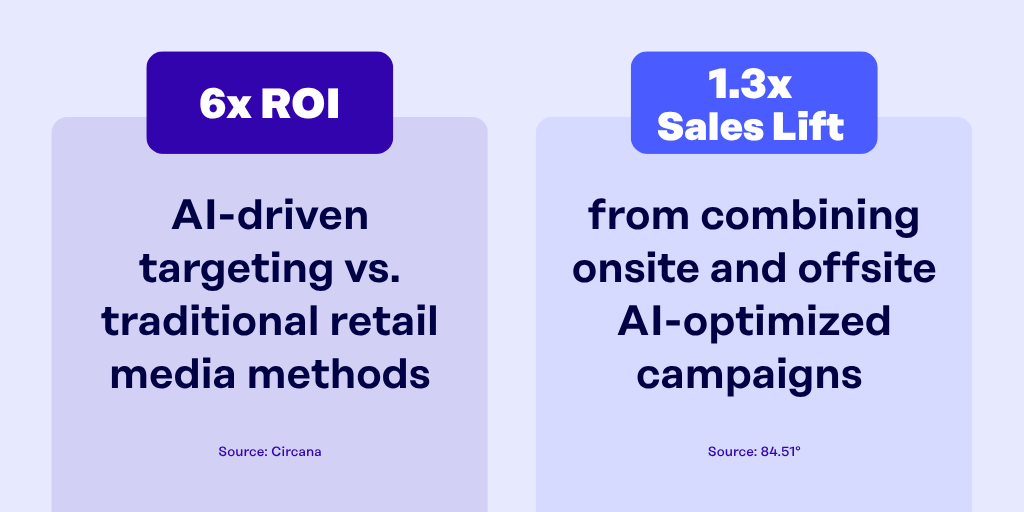
Better results: AI-driven targeting delivers 6x more ROI than traditional methods, and AI-optimized campaigns generate 1.3x higher sales lift
Trend #8: First-Party Data Is Becoming Critical in a Privacy-First Advertising Landscape
Because privacy regulations are limiting retail companies' ability to track shoppers, retailers are doubling down on first-party data assets like loyalty programs, behavioral data, and purchase history. And the data retail media can offer is increasingly valuable for brands. In particular, they can use it to build precise campaigns tailored to proven behavior and link outcomes to SKU-level sales.
Brands are growing their own customer databases and using secure technology to combine their data with retailer first-party data while protecting shopper privacy. In fact, as of 2024, 71% of brands, agencies, and publishers were expanding their first-party datasets, nearly double the 2022 figure.
Here’s why it's happening:
-
Cookies are going away: Browsers are blocking the tracking tools advertisers have relied on for years, forcing brands to find new ways to reach customers
-
Better data quality: First-party data comes directly from customers who've agreed to share it, making it more accurate and less risky from a legal perspective
-
Retailers know what people actually buy: Unlike Facebook and Google, which only track clicks and searches, retailers have real first-party data from shoppers
As an example, Instacart recently launched Data Hub, a clean room solution that lets CPG brands securely combine their customer data with Instacart's grocery purchase data. Brands can build custom audiences, measure campaign impact, and gain insights into shopping behavior without exposing individual shopper information.
Trend #9: Specialized Retailers Are Launching Media Networks for Engaged, Niche Audiences
Major brands dominate US retail media spend, accounting for over 80% of total ad dollars. But advertisers are increasingly seeking more defined, high-intent consumer segments. The remaining 16.8% of the market is fragmented across a growing group of RMNs focused on specific categories and shopper types.
Niche retail media networks (think: beauty, home improvement, specialty grocery, outdoor recreation) are standing up media offerings that rely on deep category expertise and highly engaged audiences. To compete with the big players, these smaller networks need to prove their ad placements work – which means building better measurement and precise targeting tools.
Several developments are accelerating this trend:
-
Highly engaged audiences: Shoppers in niche categories (for example, pet owners, fitness enthusiasts, or DIY hobbyists) demonstrate stronger emotional investment and higher category engagement
-
Less competition for ad space: Brands get better visibility and lower costs in niche networks because they're not competing against hundreds of other advertisers for the same placements
-
Improved tech capabilities: Emerging retail media networks are closing the gap with larger networks by building better measurement, standardized formats, and easier integrations with the ad platforms brands already use
Large networks offer huge audiences, every ad format imaginable, and sophisticated measurement. The downside? Ads cost more, and brands compete heavily for attention. On the other hand, niche networks offer smaller but more engaged audiences, lower prices, and more flexibility while still building out their ad formats and measurement tools.
Examples include Ace Hardware's RedVest Media for DIY shoppers and Cotswold Outdoor's Media Portal for outdoor enthusiasts. As niche networks grow, they face the same pressure as the giants: prove the ads work. That pressure is pushing retailers and brands to restructure their teams around retail media.
Trend #10: Retailers and Brands Are Restructuring Teams Around Retail Media
Retailers and brands are working to break down traditional team silos in order to compete in retail media. Brand marketers and retail media specialists are coming together to use retailers' first-party data for campaigns that build awareness and drive sales. Retailers are also bringing media, marketing, and merchandising together in unified teams that can coordinate across the entire business.
Data and technology are driving these changes, such that retailers are building systems to connect their owned channels (website, app, stores) with offsite advertising. This eliminates duplicate work and creates new roles that bridge team categories.
Why now?
-
Retailers have the data consumer brands need: First-party customer data is becoming essential for brand advertising. Bringing brand marketing and retail media teams together helps brands actively use those insights
-
Collaboration cuts waste: When teams work together instead of in silos, retailers can grow media revenue streams while still delivering on marketing and merchandising goals
Case in point: Kroger recently unified its retail media, insights, and loyalty marketing under one division called Kroger Precision Marketing (KPM). This combines Kroger's customer data with its media and insights teams, so advertisers can run integrated campaigns and track performance across all channels.
Putting Retail Media Network Trends Into Action In-Store
In-store media shows up across many of these trends – and retailers that treat audio, digital displays, and TV as parts of one system (instead of separate vendors) have a major advantage.
To execute on these trends, retailers need infrastructure that can deliver:
-
Reliable systems (99%+ uptime) that don't require constant IT support
-
Fast deployment that works at scale (think 30 minutes or less per location)
-
One platform that controls music, signage, TV, and on-site advertising -- not multiple logins and interfaces
-
Cloud-based management to update content across thousands of locations instantly
-
Connections to existing systems (POS, loyalty programs, CRM) so retail media can use actual customer data
-
Flexibility and oversight, to customize content by location while maintaining centralized control
Optimizing Your Location for the Current Retail Media Market
Here are five steps to help retailers strengthen their customer engagement strategies (and results) in physical locations:
1. Evaluate your in-store media against these trends
Use these 10 trends as a checklist. Are you offering full-funnel capabilities in-store, or just bottom-funnel promotions? Can you update content in real-time based on inventory or weather (Trend #2)? Is your measurement third-party verified (Trend #5)? Identify where your in-store offering has gaps compared to what brands now expect.
2. Upgrade measurement to meet new standards
If you're already running in-store media, make sure your measurement can withstand scrutiny. As the advertising industry moves toward IAB/MRC certification and third-party verification, self-reported metrics won't cut it. Ensure your systems provide auditable impression data that advertisers can trust and compare across networks.
3. Consolidate fragmented systems
If you're managing music through one technology provider, digital displays through another, and TV through a third, you're making campaigns harder to coordinate and harder to sell. Consolidating to a unified platform simplifies operations, reduces costs, and lets you offer brands true omnichannel in-store campaigns. Plus, in Rockbot’s case, our solutions work even better together, allowing retailers to align campaigns across different channels to create a multi-sensory experience.
4. Expand beyond static promotions
If your in-store media is limited to sponsored endcaps or static posters, you're missing the dynamic, AI-powered capabilities brands now expect (Trends #2 and #7). Add audio messaging, programmatic digital signage, or connected TV to give brands more ways to reach shoppers throughout the store.
5. Break down internal silos
Even if you have the right technology, retail media fails when teams work in isolation. Make sure marketing, IT, merchandising, and store operations are aligned on in-store media strategy. The right platform gives each team appropriate access without creating chaos.
The Bottom Line for In-Store Retail Media Networks
In-store media is fast becoming an essential revenue driver. Brands are demanding the ability to reach shoppers at the point of decision – with audio, video, and dynamic signage that work together, not in isolation. Retailers still managing in-store media through disconnected systems will struggle to compete for advertising dollars.
Rockbot's unified platform handles music, digital signage, curated TV, and in-store advertising from a single system built for enterprise scale. Nearly 50,000 locations – including Walmart and Sam's Club – use Rockbot to deliver coordinated in-store experiences and monetize their physical spaces.
Ready to move forward?
-
Download the full Coresight Research report on retail media trends
-
Schedule a conversation with Rockbot about bringing these trends to your stores