---
title: "Retail & Commerce Media: Bridging In-Store Gaps | Rockbot"
description: Retail media and commerce media aren't the same thing. Here's how the two categories overlap and what it takes to build a media network that wins.
image: https://blog.rockbot.com/hubfs/Blog-Feature%20(1).jpg
---
[](https://rockbot.com)
- Products
## Audio
Control everything customers hear in your business
- [ Music Deliver your ideal sound](https://rockbot.com/music-for-business)
- [ Audio Messaging Amplify your brand’s voice](https://rockbot.com/audio-messaging)
- [ Rockbot Request Let guests be the DJ](https://rockbot.com/request)
## [Retail Media Monetize your in‑store media with audio and visual ads Learn More](https://rockbot.com/retail-media)
## Video
Manage all aspects of visual media in your business
- [ Digital Signage Bring your location to life](https://rockbot.com/digital-signage-for-business)
- [ Rockbot TV Captivate your audience](https://rockbot.com/tv-for-business)
- [ Music Videos Top artists on your screens](https://rockbot.com/music-videos)
## [Advertise with us Reach your audience through premium, out-of-home multi-media ads Learn More](https://rockbot.com/advertising)
## [Media Players & Devices Power your business media with reliable, scalable hardware Explore](https://rockbot.com/hardware)
- Industries
## Industries
Smarter media solutions built for your business
- [Retail](https://rockbot.com/retail)
- [Restaurants](https://rockbot.com/restaurants)
- [Fitness](https://rockbot.com/fitness)
- [Automotive](https://rockbot.com/automotive)
- [Bars](https://rockbot.com/bars)
- [Casinos](https://rockbot.com/casinos)
- [Corporate Offices](https://rockbot.com/corporate-offices)
- [Education](https://rockbot.com/education)
- [Entertainment Venues](https://rockbot.com/entertainment-venues)
- [Financial Services](https://rockbot.com/financial-services)
- [Grocery](https://rockbot.com/grocery)
- [Healthcare](https://rockbot.com/healthcare)
- [Hospitality](https://rockbot.com/hospitality)
- [Property Management](https://rockbot.com/property-management)
- [QSR](https://rockbot.com/qsr)
- [Salon & Spa](https://rockbot.com/salon-and-spa)
- Resources
## Explore Rockbot
Stories, insights, and the team behind the platform
- [Customer Stories](https://rockbot.com/customer-stories)
- [Rockbot Blog](https://blog.rockbot.com/)
- [About Us](https://rockbot.com/about-us)
## Getting Started
Everything you need to get started
- [Hardware Setup](https://rockbot.com/hardware/setup)
- [Quick Start Guides](https://support.rockbot.com/hc/en-us/sections/7705718076571)
- [Help & Support](https://support.rockbot.com/hc/en-us)
- [Developer Portal](https://developer.rockbot.com/)
- [Pricing](https://rockbot.com/pricing)
[Login](https://rockbot.com/login) [Contact Sales](https://rockbot.com/contact-sales)
[Login](https://rockbot.com/login) [Contact Sales](https://rockbot.com/contact-sales)
- Products
## Audio
Control everything customers hear in your business
- [ Music Deliver your ideal sound](https://rockbot.com/music-for-business)
- [ Audio Messaging Amplify your brand’s voice](https://rockbot.com/audio-messaging)
- [ Rockbot Request Let guests be the DJ](https://rockbot.com/request)
## [Retail Media Monetize your in‑store media with audio and visual ads Learn More](https://rockbot.com/retail-media)
## Video
Manage all aspects of visual media in your business
- [ Digital Signage Bring your location to life](https://rockbot.com/digital-signage-for-business)
- [ Rockbot TV Captivate your audience](https://rockbot.com/tv-for-business)
- [ Music Videos Top artists on your screens](https://rockbot.com/music-videos)
## [Advertise with us Reach your audience through premium, out-of-home multi-media ads Learn More](https://rockbot.com/advertising)
## [Media Players & Devices Power your business media with reliable, scalable hardware Explore](https://rockbot.com/hardware)
- Industries
## Industries
Smarter media solutions built for your business
- [Retail](https://rockbot.com/retail)
- [Restaurants](https://rockbot.com/restaurants)
- [Fitness](https://rockbot.com/fitness)
- [Automotive](https://rockbot.com/automotive)
- [Bars](https://rockbot.com/bars)
- [Casinos](https://rockbot.com/casinos)
- [Corporate Offices](https://rockbot.com/corporate-offices)
- [Education](https://rockbot.com/education)
- [Entertainment Venues](https://rockbot.com/entertainment-venues)
- [Financial Services](https://rockbot.com/financial-services)
- [Grocery](https://rockbot.com/grocery)
- [Healthcare](https://rockbot.com/healthcare)
- [Hospitality](https://rockbot.com/hospitality)
- [Property Management](https://rockbot.com/property-management)
- [QSR](https://rockbot.com/qsr)
- [Salon & Spa](https://rockbot.com/salon-and-spa)
- Resources
## Explore Rockbot
Stories, insights, and the team behind the platform
- [Customer Stories](https://rockbot.com/customer-stories)
- [Rockbot Blog](https://blog.rockbot.com/)
- [About Us](https://rockbot.com/about-us)
## Getting Started
Everything you need to get started
- [Hardware Setup](https://rockbot.com/hardware/setup)
- [Quick Start Guides](https://support.rockbot.com/hc/en-us/sections/7705718076571)
- [Help & Support](https://support.rockbot.com/hc/en-us)
- [Developer Portal](https://developer.rockbot.com/)
- [Pricing](https://rockbot.com/pricing)
[Login](https://rockbot.com/login) [Contact Sales](https://rockbot.com/contact-sales)
# Retail Media, Commerce Media, and the Physical Location Gap
Last updated | September 8, 2026
 Rachel Mindell, Strategic Content Marketing Manager
.jpg)
[Rachel Mindell, Strategic Content Marketing Manager](https://blog.rockbot.com/author/rachel-mindell-1)
##### Share
- [**](https://www.linkedin.com/shareArticle?mini=true&url={url}&title={title})
- [**](https://www.facebook.com/sharer.php?u={url})
- [**](https://twitter.com/intent/tweet?url={url}&text={title})
Table of Contents ▾
### Table of Contents
### Key Takeaways
- **Retail Media Is Commerce Media's Dominant Force, But Not the Whole Story:** Retail media accounts for the largest share of commerce media ad spend, but the category now extends to airlines, financial platforms, and delivery apps – all monetizing first-party transaction data for partner advertising.
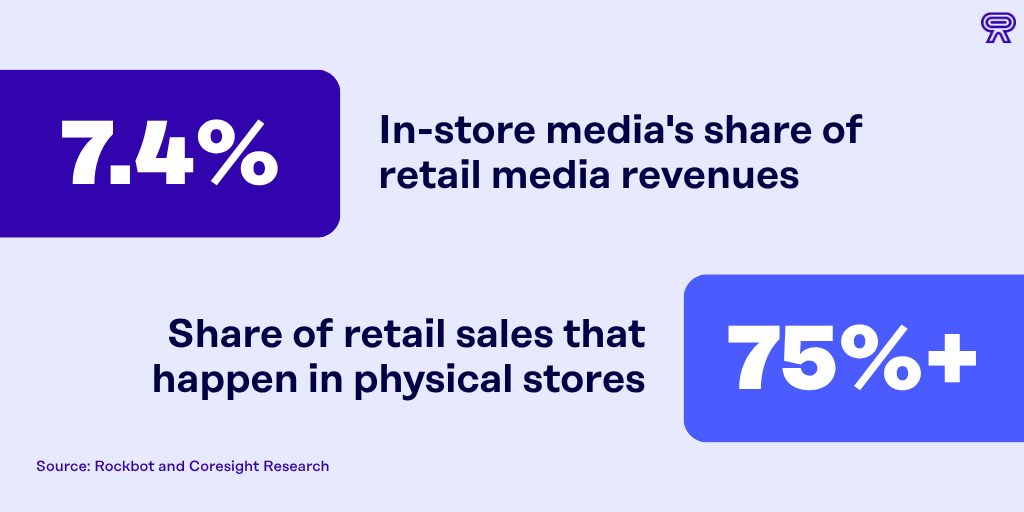
- **Physical Locations Are Retail Media's Biggest Blind Spot:** In-store media accounts for only 7.4% of retail media revenues despite over three-fourths of retail sales happening in physical locations – leaving a significant gap between where transactions occur and where media investment flows.
- **Commerce Media's Full-Funnel Shift Is Already Underway:** Brand building has overtaken conversion as the #1 advertiser objective in retail media, signaling that commerce media networks need to prove upper-funnel value, not just last-click attribution.
- **First-Party Data From Physical Locations Is a Structural Advantage:** As privacy regulations tighten and third-party signals disappear, physical locations generate the kind of contextual, transactional data that no digital channel can replicate – making in-location commerce media an increasingly valuable part of any first-party data strategy.
- **Built but Not Optimized:** 77% of US retailers have deployed dynamic in-location media capabilities, but only 32% have mature, optimized programs – the infrastructure exists, the execution doesn't yet.
- **Measurement Is the Top Capability Advertisers Expect From Commerce Media Networks:** When evaluating networks, advertisers rank targeting, measurement, and attribution as their #1 next-generation requirement – ahead of data capabilities, AI-driven optimization, and omnichannel integration.
Retail media and commerce media are often used synonymously, but they describe different things. **Retail media** refers specifically to advertising sold by retailers using their own first-party shopper data, including sponsored search on marketplace sites, display ads on a grocery chain's app, and promoted placements on a retailer's website. **Commerce media,** as a broader category that includes retail media, is the monetization of first-party transaction data as advertising inventory – the idea being that any company sitting between a consumer and a purchase has something valuable to sell to advertisers.
For example, a hotel chain selling ads to travel brands based on booking history, or a bank promoting financial products based on spending patterns, are types of commerce media. The distinction between retail and commerce media matters because the latter has expanded well beyond its retail origins, and the competitive landscape for advertiser budgets looks very different as a result.
Building a commerce media strategy – whether as a retailer or otherwise – requires understanding how these categories diverge and where the biggest commerce media network opportunities remain.
## How Retail Media Became Commerce Media
Amazon launched its advertising business in 2012 and spent the following decade building the infrastructure that turned retailer first-party data into a serious ad channel. Other retailers built on this model, and by the late 2010s, retail media had a name and a business model. The early playbook was straightforward: leverage the e-commerce search results, sell sponsored placements, and measure everything through last-click attribution
As it turns out, this approach is useful for businesses beyond retail. Any company with transaction history and direct customer relationships can partner with advertisers to unlock new revenue. Travel companies, financial platforms, delivery apps, and hospitality brands have all built ad businesses on top of their first-party data. This expansion of an approach focused on retail to other markets gave rise to new terminology (commerce media) and scale.
In other words, commerce media describes the business model (any company monetizing transaction data as ad inventory), and retail media describes who's doing it (retailers specifically).
## Understanding the Landscape
[According to EMARKETER](https://www.emarketer.com/commerce-media-lookbook/), non-retail commerce media ad spending is forecast to grow 82.46% between 2025 and 2027, reaching $13.21 billion. That's a fast-growing slice of the category – but still a fraction of the whole. US commerce media is forecast to reach $116.06 billion by 2029, with retail media already accounting for $68.99 billion of that – 16.8% of total digital ad spend in 2026 – making it the largest and most developed part of the broader category.
Despite retail media’s scale, the in-store share of overall retail media revenues has only increased by [7.3% over the past 12 months](https://blog.rockbot.com/in-store-retail-media-news-2026-coresight#:~:text=These%20results%20make,currently%20to%20~9.1%25.) – and is still expected to grow by 23% over the coming 12 months, underscoring the runway that remains.
This to say: retail media is dominant within commerce media, but within retail media itself, the physical store is still dramatically underrepresented, given where most sales happen. To understand where that in-store opportunity actually stands, Rockbot partnered with Coresight Research to survey 250 U.S. retail executives on the current state of in-store retail media. [Download the full report here.](https://info.rockbot.com/coresight-in-store-retail-media-report?hsLang=en)
[](https://info.rockbot.com/coresight-in-store-retail-media-report?hsLang=en)
## Retail Media Networks Are the Fastest-Growing Ad Channel
As commerce media expands and advertisers spread budgets across more networks (a median of approximately [six per advertiser](https://www.mckinsey.com/capabilities/growth-marketing-and-sales/our-insights/commerce-media-at-an-inflection-point-how-to-win-with-a-full-stack-approach#:~:text=Multinetwork%20strategies%20become,a%20year%20earlier.), up from four a year earlier), the question of what makes a retail media network worth keeping in the mix has become more urgent. Retail media is the dominant force in commerce media, but dominance at the category level doesn't automatically translate to growth at the network level.
[97% of retailers](https://blog.rockbot.com/in-store-retail-media-news-2026-coresight#:~:text=97%25%0Aare%20actively%20investing%20to%20scale%20in%2Dstore%20retail%20media%20capabilities%20and%2087%25%20plan%20to%20increase%20that%20investment%20further%20over%20the%20next%2024%20months.) are investing to scale their in-store retail media, and 87% plan to increase investment over the next 24 months. But there are factors challenging how effective these endeavors will be. First, brands face what you might call a “concentration problem.” Retail media’s dominance is heavily concentrated, with a few major brands dominating US retail media spend, accounting for over [80% of total ad dollars](https://blog.rockbot.com/retail-media-trends-2026#:~:text=individual%20shopper%20information.-,Trend%20%239%3A%20Specialized%20Retailers%20Are%20Launching%20Media%20Networks%20for%20Engaged%2C%20Niche,growing%20group%20of%20RMNs%20focused%20on%20specific%20categories%20and%20shopper%20types.,-Niche%20retail%20media). The same holds for commerce media, with the same brands accounting for [89.2% of ad spend](https://www.emarketer.com/commerce-media-lookbook/).
Relatedly, consolidation is changing the market. Avery Akkineni, CMO at VaynerX, told Marketing Brew that after three years of explosive network growth, the market is entering[ a "cool-off" phase](https://www.marketingbrew.com/stories/2026/01/07/commerce-media-retail-media-in-2026-ai-) – marketers are zeroing in on the networks most effective for their brands rather than spreading budgets across dozens. Freddy Dabaghi, chief transformation officer at Crispin, expects brands to increasingly route spend through ad-tech vendors that can connect multiple networks rather than managing each separately.
In a commerce media landscape where advertiser budgets are limited and undergoing consolidation, the retail media networks that survive will offer something genuinely distinct – for example, unique audience access or inventory that can't be replicated digitally. For most physical retailers, that differentiation can happen in-store.
## How Commerce Media Fits Into an Omnichannel Strategy
In the context of commerce media, an omnichannel approach refers to the creation of a shopper journey where measurement connects what happens online to what happens in the aisle (as opposed to selling across channels). Here’s why this unification matters:
- [47% of advertisers](https://www.mckinsey.com/capabilities/growth-marketing-and-sales/our-insights/commerce-media-at-an-inflection-point-how-to-win-with-a-full-stack-approach) now use in-store advertising as part of their commerce media strategy (up from 35% a year ago) – but nearly 8 in 10 find it at least moderately difficult to integrate in-store results into broader CMN (commerce media network) reporting.
- In-store retail media's share of overall retail media revenues is growing but still falls dramatically behind physical sales, which account for over three-fourths of [total retail transactions](https://capitaloneshopping.com/research/online-vs-in-store-shopping-statistics).
[According to Sarah Richter](https://www.thedrum.com/news/the-physical-store-is-no-longer-retail-s-endpoint-but-commerce-media-s-starting-point), CMO at SAP, in-store is "just as much of a channel and interaction point as any of the digital channels we now have." What a true omnichannel strategy would require is that a brand define an audience once and activate it across on-site, off-site, and in-store, with results in a single reporting view. And the truth is, most networks can’t deliver on this currently.
## The Commerce Media Trends Defining 2026
The executives closest to this market are describing a shift in how they think about the physical store – seeing it as an active media environment rather than a distribution endpoint.
Walmart Connect's Khurrum Malik has described the store as an advertising surface [running continuously](https://www.thedrum.com/news/the-physical-store-is-no-longer-retail-s-endpoint-but-commerce-media-s-starting-point#:~:text=Walmart%20sees%20that,build%20brand%20resonance.%E2%80%9D) from the bakery to the checkout counter, and Best Buy's Lisa Valentino has made the case that a thousand-store footprint generates demand through the kind of [storytelling and contextual connection](https://www.thedrum.com/news/the-physical-store-is-no-longer-retail-s-endpoint-but-commerce-media-s-starting-point) that a digital placement can approximate but not replicate.
Our survey data supports the direction: [98% of the retail leaders surveyed](https://blog.rockbot.com/in-store-retail-media-measurement?hsLang=en#:~:text=In%2Dstore%20retail%20media%20is%20gaining%20momentum%2C%20with%2098%25%20of%20survey%20respondents%20prioritizing%20it%20either%20moderately%20or%20strongly.) are moderately or strongly prioritizing in-store retail media right now, which suggests this isn't aspirational thinking – investments are already moving.
What's driving that prioritization is partly a shift in what advertisers are actually asking for. [Brand building has overtaken conversion](https://blog.rockbot.com/in-store-retail-media-news-2026-coresight?hsLang=en#:~:text=Namely%2C%20brand%20building%20has%20overtaken%20conversion%20as%20the%20%231%20advertiser%20objective%20for%20in%2Dstore%20retail%20media.) as the leading objective retail leaders cite when describing advertiser demand, with 28% ranking it first, and new product launches close behind at 25%.
Both require upper-funnel capability – reach, frequency, and the ability to create associations rather than just capture intent. As it turns out, the in-location environment is well-suited to that, particularly through overhead audio and contextually placed screens that connect a message to the moment of consideration, not just the moment of purchase.
AI sits underneath much of this as enabling infrastructure. McKinsey's survey of advertising decision-makers found that [about a third plan to use AI daily](https://www.mckinsey.com/capabilities/growth-marketing-and-sales/our-insights/commerce-media-at-an-inflection-point-how-to-win-with-a-full-stack-approach#:~:text=AI%20is%20no,capabilities%20for%20CMNs.) across commerce media activities within 12 months, with optimization and audience modeling ranking among the capabilities they most expect networks to offer.
In-location, AI makes daypart targeting and dynamic content adjustment practical at scale – but only when the underlying platform is unified enough to act on those signals in real time. That's the piece most programs are still working to build.
## Why the Physical Locations May Be Commerce Media's Biggest Untapped Opportunity
Several data points indicate that a brand’s physical locations represent an underprioritized media opportunity:
- **The revenue gap:** Considering how many sales happen in physical stores, it’s surprising that, according to our report, in-store media accounts for only 7.4% of retail media revenues. And given that retail media is the dominant force in commerce media, it feels safe to assume that physical locations are also a blind spot in the broader category (applicable to, for example, hotels and gyms)
- **Proof points:** Walmart data shows multichannel and omnichannel campaigns outperform social media alone by [as much as 2.5x](https://www.walmartconnect.com/resources/articles/2026/expanding-retail-powered-social-media) across both in-store and digital sales – meaning the in-location component is actively improving performance across the rest of the commerce media strategy
- **Built but not optimized:** 77% of US retailers deploy dynamic retail media capabilities in-store – digital screens (86%) and audio (81%) – but only 32% have mature, optimized programs, according to our survey. The infrastructure exists, but the maturity isn’t there yet.
- **Considering ROI:** According to Jordan Cuddy, EVP at Monks,in-store first-party datais "[itself a return on investment](https://www.thedrum.com/news/the-physical-store-is-no-longer-retail-s-endpoint-but-commerce-media-s-starting-point)," since it is contextually rich and exclusive to the physical channel (and unavailable to any CMN without a physical footprint)
- **AI resilience:** In-store is the commerce media channel [least exposed t](https://new.adotat.com/products/retail-media-report-2026-the-70-billion-lie)[o disruption](https://new.adotat.com/products/retail-media-report-2026-the-70-billion-lie) from AI agents – the one surface where brands can reach shoppers at the moment of decision without digital interference.
So, who is getting it right – and how?
## Commerce Media in Action: What Leading Retailers Are Building
Brands leading in commerce media right now are not waiting for a perfect playbook – they're building in-location infrastructure and figuring out the measurement as they go.
Ahold Delhaize launched [AD Retail Media](https://www.adretailmedia.nl/) in January 2026, building a single platform that integrates onsite display, sponsored search, and in-store digital screens so that brands have one place to plan, buy, and measure campaigns across physical and digital channels simultaneously. This integration removes the friction that has historically made in-location media harder to buy than digital inventory, and positions Ahold Delhaize as a genuine full-stack commerce media partner (not a digital network with an in-store add-on).
[United Airlines' Kinective Media](https://apex.aero/articles/apex-tech-2026-inside-the-united-approach-to-inflight-engagement-with-kinective-media/) shows how far the commerce media model extends beyond retail. Using first-party data from flight records and real-time passenger behavior, United turns the seatback screen into a full-funnel advertising platform – personalizing content and offers based on travel context and loyalty signals. The brand closes the loop by tracking engagement from onboard through to post-flight behavior. Mike Petrella, United's Managing Director of Strategic Partnerships, described it as "not just brand awareness, but full-funnel engagement."
[Best Buy Ads](https://www.retailbrew.com/stories/2026/01/29/why-best-buy-s-in-store-ads-are-a-big-hit-with-brands) has taken a different approach with what it calls "takeover packages," letting advertisers control multiple touchpoints across a location simultaneously (from window displays and entrances to TV walls and interactive screens). Demand has been strong enough that the packages are nearly sold out for the year, with brands including IKEA and Meta among the buyers. Lisa Valentino, president of Best Buy Ads, described them as the "biggest driver of demand" from advertisers at NRF 2026.
What these programs have in common is unified infrastructure – and what makes them hard to replicate is the absence of it. That's what Rockbot provides: screens, audio, and analytics in one place, integrated with the broader commerce media ecosystem. Walmart and Sam's Club have worked with Rockbot since 2023 to do exactly that – delivering [music and audio promotions](https://blog.rockbot.com/in-store-retail-media-and-audio?hsLang=en) through existing speaker infrastructure, enabling daypart targeting and localized content without large-scale signage costs.
For retailers looking to close the gap between digital and physical commerce media performance, unified in-location infrastructure is the entry point — and the competitive differentiator that pure-play digital networks can't replicate.
## How to Build a Commerce Media Strategy That Includes Your Location
The following best practices draw on insights from our recent report and other industry thought leadership on in-location commerce media. Each should feel applicable to anyone building or managing a commerce media network: retailer, airline, financial platform, or otherwise.
- **Treat the physical location as a primary commerce media channel**: Your location is a channel with its own technology, content strategy, and measurement framework – not an add-on to a digital strategy. The networks that integrate it fully will have inventory that no digital-native competitor can replicate.
- **Start with the full funnel: Build commerce media strategies that span from** awareness to conversion from day one. Brand building is now the #1 advertiser objective, and last-click attribution simply isn’t enough to secure continuing partnerships.
- **Build your first-party data advantage now**: Physical locations are among the richest sources of first-party data available (the kind of contextual, transactional signals that digital can’t match), and the networks that capture and activate it well will have an immense structural advantage.
- **Know what advertisers are grading you on**: When evaluating commerce media networks, [advertisers rank targeting, measurement, and attribution](https://www.mckinsey.com/capabilities/growth-marketing-and-sales/our-insights/commerce-media-at-an-inflection-point-how-to-win-with-a-full-stack-approach#:~:text=The%20measurement%20mandate%3A%20Advertisers%20demand%20transparency) as their top next-generation requirement, with data capabilities and AI-driven optimization close behind. Networks that can prove what happened in a physical location and show how AI improved the outcome will be the ones that retain and grow advertiser budgets.
For retail, the gap between what advertisers expect and what most networks can currently deliver is significant – [44% of retailers](https://blog.rockbot.com/in-store-retail-media-measurement?hsLang=en#:~:text=The%20data%20shows%20that%2044%25%20of%20retailers%20can%27t%20measure%20the%20overall%20impact%20of%20their%20in%2Dstore%20programs.%20And%20in%20a%20market%20growing%20at%2014%25%20YoY%2C%20the%20retailers%20that%20close%20that%20gap%20first%20will%20have%20a%20structural%20advantage%20over%20everyone%20else.) still can't measure the overall impact of their in-location programs.
.png?width=1024&height=512&name=Retail%20Media%2c%20Commerce%20Media%2c%20and%20the%20Physical%20Location%20Gap%20(2).png)
## The Networks That Win Commerce Media Will Leverage Physical Locations
Commerce media is growing: global retail media alone is forecast to reach [$312 billion by 2030](https://www.forrester.com/blogs/global-retail-media-forecast-2030/), more than twice the projected size of global TV advertising at that point. But major areas of opportunity remain untapped. Brands that activate physical locations can check every box that commerce media success requires: first-party data at the point of transaction, full-funnel reach, and inventory that digital competitors can’t replicate.
The retailers and networks that build unified infrastructure now – connecting their physical locations to the broader commerce media ecosystem – will likely be the ones that define what the category looks like at maturity. This is exactly what the [Rockbot retail media ](https://rockbot.com/retail-media)[solution ](https://rockbot.com/retail-media)is built to do, offering unified in-location media infrastructure that connects screens, audio, and analytics and integrates with the broader commerce media ecosystem.
The infrastructure gap, measurement challenges, and maturity divide shaping in-store retail media right now are documented in full in the Rockbot and Coresight Research report, based on a survey of 250 U.S. retail executives.
Download it here: [https://info.rockbot.com/coresight-in-store-retail-media-report](https://info.rockbot.com/coresight-in-store-retail-media-report?hsLang=en)
## Frequently Asked Questions
What Is Commerce Media?
Commerce media is the monetization of first-party transaction data as advertising inventory. The core idea is that any company sitting between a consumer and a purchase has something valuable to sell to advertisers – not just retailers, but airlines, gyms, financial platforms, delivery apps, and hospitality brands as well. Commerce media describes the business model itself: using proprietary data on what people buy, where they go, and how they spend to deliver ads that are measurable, relevant, and directly tied to consumer behavior.
What Is an Example of Commerce Media?
Examples of commerce media include a hotel chain selling ads to travel brands based on guest booking history, a bank promoting financial products to customers based on their spending patterns, or a delivery platform offering sponsored placements to restaurants based on order data. Retail media – advertising sold by retailers using their own shopper data, such as sponsored search on a grocery chain's app or display ads on a retailer's website – is the largest and most established form of commerce media, but the model now extends well beyond retail.
What Are the Key Differences Between Retail Media and Commerce Media?
The key differences between retail media and commerce media come down to scope. Retail media refers specifically to advertising sold by retailers using first-party shopper data – think promoted placements on a grocery chain's website or a sponsored message on a retail store’s digital sign.
Commerce media is the broader category that retail media sits inside: any company with transaction data and a direct customer relationship can build an advertising business on top of that access, whether they're a retailer, an airline, or a financial services provider. Retail media is the dominant force within commerce media, accounting for [$68.99 billion of US digital ad spend](https://www.emarketer.com/commerce-media-lookbook/) in 2026.
What Is the Meaning of In-Location Commerce Media?
In-location commerce media refers to advertising delivered through media channels within a physical location – such as digital screens, audio systems, or interactive displays – as part of a broader commerce media strategy. The meaning of in-location commerce media extends beyond traditional retail: any physical environment where a transaction takes place, from a grocery store to an airport gate to a hotel lobby, can function as a commerce media channel if the operator has first-party data and the infrastructure to activate it.
In-location commerce media is significant because physical locations capture shopper intent at its highest point – the moment of decision – and generate contextually rich first-party data that digital channels cannot replicate.
What Is an Example of In-Store Media?
An example of in-store media is a digital screen at the end of a grocery store aisle displaying a targeted ad for a product based on the time of day or the store's current inventory. Other examples include audio promotions delivered through a retailer's in-store speaker system, or interactive screens near checkout that display relevant offers based on a shopper's loyalty data. In-store media is part of the broader retail media network strategy, allowing brands to reach shoppers at the physical point of purchase with contextually relevant messaging that digital channels cannot match.

Rachel Mindell, Strategic Content Marketing Manager
Author
Rachel Mindell leads content ideation and execution across channels at Rockbot, with a focus on creating lasting value for clients and prospects via commercial in-location media. Based in Tucson, Arizona, she's also a singer, book nerd, and fitness enthusiast who loves getting out in nature.
## Sign up for the newsletter
- Products
- [Music](https://rockbot.com/music-for-business)
- [Audio Messaging](https://rockbot.com/audio-messaging)
- [Rockbot Request](https://rockbot.com/request)
- [Digital Signage](https://rockbot.com/digital-signage-for-business)
- [Rockbot TV](https://rockbot.com/tv-for-business)
- [Music Videos](https://rockbot.com/music-videos)
- [Retail Media](https://rockbot.com/retail-media)
- [Advertising](https://rockbot.com/advertising)
- [Platform](https://rockbot.com/platform)
- [Pricing](https://rockbot.com/pricing)
- Hardware
- [Media Players & Devices](https://rockbot.com/hardware)
- [Rockbot Smart Amp](https://rockbot.com/hardware/smart-amp)
- [Rockbot Media Player](https://rockbot.com/hardware/media-player)
- [Amazon Signage Stick](https://rockbot.com/hardware/amazon-signage-stick)
- Industries
- [Retail](https://rockbot.com/retail)
- [Restaurants](https://rockbot.com/restaurants)
- [Fitness](https://rockbot.com/fitness)
- [Automotive](https://rockbot.com/automotive)
- [Bars](https://rockbot.com/bars)
- [Casinos](https://rockbot.com/casinos)
- [Corporate Offices](https://rockbot.com/corporate-offices)
- [Education](https://rockbot.com/education)
- [Entertainment Venues](https://rockbot.com/entertainment-venues)
- [Financial Services](https://rockbot.com/financial-services)
- [Grocery](https://rockbot.com/grocery)
- [Healthcare](https://rockbot.com/healthcare)
- [Hospitality](https://rockbot.com/hospitality)
- [Property Management](https://rockbot.com/property-management)
- [QSR](https://rockbot.com/qsr)
- [Salon & Spa](https://rockbot.com/salon-and-spa)
- Resources
- [Getting Started](https://support.rockbot.com/hc/en-us/categories/360000775171-Getting-Started)
- [Hardware Setup](https://rockbot.com/setup)
- [Quick Start Guides](https://support.rockbot.com/hc/en-us/sections/7705718076571)
- [Developer Portal](https://developer.rockbot.com/)
- [Request App Promo Toolkit](https://rockbot.com/request-promo-assets)
- [Help & Support](https://support.rockbot.com/hc/en-us)
- [Blog](https://blog.rockbot.com)
- [Customer Stories](https://rockbot.com/customer-stories)
- [Rockbot News](https://blog.rockbot.com/pr)
- Apps
- [Remote App](https://rockbot.com/remote-app)
- [Request App](https://rockbot.com/request-app)
- Company
- [About](https://rockbot.com/about-us)
- [Careers](https://rockbot.com/careers)
- [Contact](https://rockbot.com/contact)
- Products
- [Music](https://rockbot.com/music-for-business)
- [Audio Messaging](https://rockbot.com/audio-messaging)
- [Rockbot Request](https://rockbot.com/request)
- [Digital Signage](https://rockbot.com/digital-signage-for-business)
- [Rockbot TV](https://rockbot.com/tv-for-business)
- [Music Videos](https://rockbot.com/music-videos)
- [Retail Media](https://rockbot.com/retail-media)
- [Advertising](https://rockbot.com/advertising)
- [Platform](https://rockbot.com/platform)
- [Pricing](https://rockbot.com/pricing)
- Hardware
- [Media Players & Devices](https://rockbot.com/hardware)
- [Rockbot Smart Amp](https://rockbot.com/hardware/smart-amp)
- [Rockbot Media Player](https://rockbot.com/hardware/media-player)
- [Amazon Signage Stick](https://rockbot.com/hardware/amazon-signage-stick)
- Industries
- [Retail](https://rockbot.com/retail)
- [Restaurants](https://rockbot.com/restaurants)
- [Fitness](https://rockbot.com/fitness)
- [Automotive](https://rockbot.com/automotive)
- [Bars](https://rockbot.com/bars)
- [Casinos](https://rockbot.com/casinos)
- [Corporate Offices](https://rockbot.com/corporate-offices)
- [Education](https://rockbot.com/education)
- [Entertainment Venues](https://rockbot.com/entertainment-venues)
- [Financial Services](https://rockbot.com/financial-services)
- [Grocery](https://rockbot.com/grocery)
- [Healthcare](https://rockbot.com/healthcare)
- [Hospitality](https://rockbot.com/hospitality)
- [Property Management](https://rockbot.com/property-management)
- [QSR](https://rockbot.com/qsr)
- [Salon & Spa](https://rockbot.com/salon-and-spa)
- Resources
- [Getting Started](https://support.rockbot.com/hc/en-us/categories/360000775171-Getting-Started)
- [Hardware Setup](https://rockbot.com/setup)
- [Quick Start Guides](https://support.rockbot.com/hc/en-us/sections/7705718076571)
- [Developer Portal](https://developer.rockbot.com/)
- [Request App Promo Toolkit](https://rockbot.com/request-promo-assets)
- [Help & Support](https://support.rockbot.com/hc/en-us)
- [Blog](https://blog.rockbot.com)
- [Customer Stories](https://rockbot.com/customer-stories)
- [Rockbot News](https://blog.rockbot.com/pr)
- Apps
- [Remote App](https://rockbot.com/remote-app)
- [Request App](https://rockbot.com/request-app)
- Company
- [About](https://rockbot.com/about-us)
- [Careers](https://rockbot.com/careers)
- [Contact](https://rockbot.com/contact)
 2026 Rockbot, Inc.
- [Terms](https://rockbot.com/terms)
- [Privacy](https://rockbot.com/privacy)
- [Licensing](https://rockbot.com/licensing)
-
-
-
-
-
```json
{
"@context" : "https://schema.org",
"@type" : "BlogPosting",
"author" : {
"@type" : "Person",
"name" : "Rachel Mindell, Strategic Content Marketing Manager",
"url" : "https://blog.rockbot.com/author/rachel-mindell-1"
},
"dateModified" : "2026-09-08T12:02:22.600Z",
"datePublished" : "2026-06-03T19:29:07.000Z",
"headline" : "Retail & Commerce Media: Bridging In-Store Gaps | Rockbot",
"image" : [ "https://blog.rockbot.com/hubfs/Blog-Feature%20(1).jpg" ],
"mainEntityOfPage" : {
"@id" : "https://blog.rockbot.com/retail-media-and-commerce-media",
"@type" : "WebPage"
},
"publisher" : {
"@type" : "Organization",
"logo" : {
"@type" : "ImageObject",
"url" : "https://blog.rockbot.com/hubfs/General%20Email%20Header.png"
},
"name" : "Rockbot"
}
}
```