---
title: Lessons in In-Store Audio & Retail Media Networks | Rockbot
description: Audio is critical for in-store retail media. Here are 5 lessons on strategy and production to help you turn audio infrastructure into ad revenue.
image: https://blog.rockbot.com/hubfs/Notes%20from%20the%20Field.png
---
[](https://rockbot.com)
- Products
## Audio
Control everything customers hear in your business
- [ Music Deliver your ideal sound](https://rockbot.com/music-for-business)
- [ Audio Messaging Amplify your brand’s voice](https://rockbot.com/audio-messaging)
- [ Rockbot Request Let guests be the DJ](https://rockbot.com/request)
## [Retail Media Monetize your in‑store media with audio and visual ads Learn More](https://rockbot.com/retail-media)
## Video
Manage all aspects of visual media in your business
- [ Digital Signage Bring your location to life](https://rockbot.com/digital-signage-for-business)
- [ Rockbot TV Captivate your audience](https://rockbot.com/tv-for-business)
- [ Music Videos Top artists on your screens](https://rockbot.com/music-videos)
## [Advertise with us Reach your audience through premium, out-of-home multi-media ads Learn More](https://rockbot.com/advertising)
## [Media Players & Devices Power your business media with reliable, scalable hardware Explore](https://rockbot.com/hardware)
- Industries
## Industries
Smarter media solutions built for your business
- [Retail](https://rockbot.com/retail)
- [Restaurants](https://rockbot.com/restaurants)
- [Fitness](https://rockbot.com/fitness)
- [Automotive](https://rockbot.com/automotive)
- [Bars](https://rockbot.com/bars)
- [Casinos](https://rockbot.com/casinos)
- [Corporate Offices](https://rockbot.com/corporate-offices)
- [Education](https://rockbot.com/education)
- [Entertainment Venues](https://rockbot.com/entertainment-venues)
- [Financial Services](https://rockbot.com/financial-services)
- [Grocery](https://rockbot.com/grocery)
- [Healthcare](https://rockbot.com/healthcare)
- [Hospitality](https://rockbot.com/hospitality)
- [Property Management](https://rockbot.com/property-management)
- [QSR](https://rockbot.com/qsr)
- [Salon & Spa](https://rockbot.com/salon-and-spa)
- Resources
## Explore Rockbot
Stories, insights, and the team behind the platform
- [Customer Stories](https://rockbot.com/customer-stories)
- [Rockbot Blog](https://blog.rockbot.com/)
- [About Us](https://rockbot.com/about-us)
## Getting Started
Everything you need to get started
- [Hardware Setup](https://rockbot.com/hardware/setup)
- [Quick Start Guides](https://support.rockbot.com/hc/en-us/sections/7705718076571)
- [Help & Support](https://support.rockbot.com/hc/en-us)
- [Developer Portal](https://developer.rockbot.com/)
- [Pricing](https://rockbot.com/pricing)
[Login](https://rockbot.com/login) [Contact Sales](https://rockbot.com/contact-sales)
[Login](https://rockbot.com/login) [Contact Sales](https://rockbot.com/contact-sales)
- Products
## Audio
Control everything customers hear in your business
- [ Music Deliver your ideal sound](https://rockbot.com/music-for-business)
- [ Audio Messaging Amplify your brand’s voice](https://rockbot.com/audio-messaging)
- [ Rockbot Request Let guests be the DJ](https://rockbot.com/request)
## [Retail Media Monetize your in‑store media with audio and visual ads Learn More](https://rockbot.com/retail-media)
## Video
Manage all aspects of visual media in your business
- [ Digital Signage Bring your location to life](https://rockbot.com/digital-signage-for-business)
- [ Rockbot TV Captivate your audience](https://rockbot.com/tv-for-business)
- [ Music Videos Top artists on your screens](https://rockbot.com/music-videos)
## [Advertise with us Reach your audience through premium, out-of-home multi-media ads Learn More](https://rockbot.com/advertising)
## [Media Players & Devices Power your business media with reliable, scalable hardware Explore](https://rockbot.com/hardware)
- Industries
## Industries
Smarter media solutions built for your business
- [Retail](https://rockbot.com/retail)
- [Restaurants](https://rockbot.com/restaurants)
- [Fitness](https://rockbot.com/fitness)
- [Automotive](https://rockbot.com/automotive)
- [Bars](https://rockbot.com/bars)
- [Casinos](https://rockbot.com/casinos)
- [Corporate Offices](https://rockbot.com/corporate-offices)
- [Education](https://rockbot.com/education)
- [Entertainment Venues](https://rockbot.com/entertainment-venues)
- [Financial Services](https://rockbot.com/financial-services)
- [Grocery](https://rockbot.com/grocery)
- [Healthcare](https://rockbot.com/healthcare)
- [Hospitality](https://rockbot.com/hospitality)
- [Property Management](https://rockbot.com/property-management)
- [QSR](https://rockbot.com/qsr)
- [Salon & Spa](https://rockbot.com/salon-and-spa)
- Resources
## Explore Rockbot
Stories, insights, and the team behind the platform
- [Customer Stories](https://rockbot.com/customer-stories)
- [Rockbot Blog](https://blog.rockbot.com/)
- [About Us](https://rockbot.com/about-us)
## Getting Started
Everything you need to get started
- [Hardware Setup](https://rockbot.com/hardware/setup)
- [Quick Start Guides](https://support.rockbot.com/hc/en-us/sections/7705718076571)
- [Help & Support](https://support.rockbot.com/hc/en-us)
- [Developer Portal](https://developer.rockbot.com/)
- [Pricing](https://rockbot.com/pricing)
[Login](https://rockbot.com/login) [Contact Sales](https://rockbot.com/contact-sales)
# Lessons from the Field: Audio and In-Store Retail Media
Last updated | September 8, 2026
 Shawn Cash, Manager, Audio Services
[Shawn Cash, Manager, Audio Services](https://blog.rockbot.com/author/shawn-cash)
##### Share
- [**](https://www.linkedin.com/shareArticle?mini=true&url={url}&title={title})
- [**](https://www.facebook.com/sharer.php?u={url})
- [**](https://twitter.com/intent/tweet?url={url}&text={title})
Table of Contents ▾
### Table of Contents
### Key Takeaways
- **Audio Reaches Shoppers That Screens Miss:** Digital signage works when shoppers are looking at it. Audio reaches shoppers throughout the store regardless of where they're focused – and research shows audio ads generate significantly higher attentive seconds per thousand impressions than other ad formats.
- **In-Store Audio Can Become a Revenue Line:** Retail media margins [run over 70%](https://info.rockbot.com/coresight-retail-media-trends-report-2026?hsLang=en), roughly [10 times larger](https://www.sciencedirect.com/science/article/pii/S0022435925000648?via%3Dihub) than traditional retail margins. Retailers already paying for music licensing and speaker infrastructure can monetize that investment by selling audio placements to brand partners.
- **Production Quality Determines Whether a Placement Performs:** A well-positioned audio ad can still underperform if the message doesn't cut through the store environment. Factors like the 7-second rule, sound design, and how a message sits within the surrounding audio all affect whether shoppers register it.
- **Dwell Time and Frequency Shape the Entire Strategy:** How long shoppers spend in a store determines how many messages they can hear and how often each should play. Getting this wrong means shoppers either leave before hearing the right messages or hear the same one too many times – both outcomes undermine the program's effectiveness for retailers and brand partners alike.
- **Consistency at Scale Is a Commercial Requirement:** Brand partners investing in audio placements need the same quality across every location. Retailers who build reliable, scalable in-store audio infrastructure now will be better positioned to attract and retain those partnerships as the market grows.
I've been in audio production for over two decades, in radio first, then retail. I joined Rockbot as Audio Services Manager in 2021, and since then, my team has worked with brands across retail, food service, and franchises, building thousands of custom audio messages for some of the country's biggest retail brands.
Retailers are building impressive in-store retail media programs, including better screens, smarter data, and stronger CPG partnerships. Audio is a meaningful part of that picture, and it can be harder to get right than it might seem. The strategy, production quality, timing, and how messages fit with the store environment – all of it matters.
Here are five lessons from that work, focused on what makes retail media perform.
## Lesson 1: You Can't Walk Past Audio
Digital signage works when shoppers are looking at it. Audio works just about everywhere.
A leader at a major office supply brand’s Canadian division ran a test that clearly made this point. The retailer who worked with me had been promoting a well-known computer brand exclusively through wall signs and in-store displays. When they added audio messaging to the mix, sales increased by 80%.
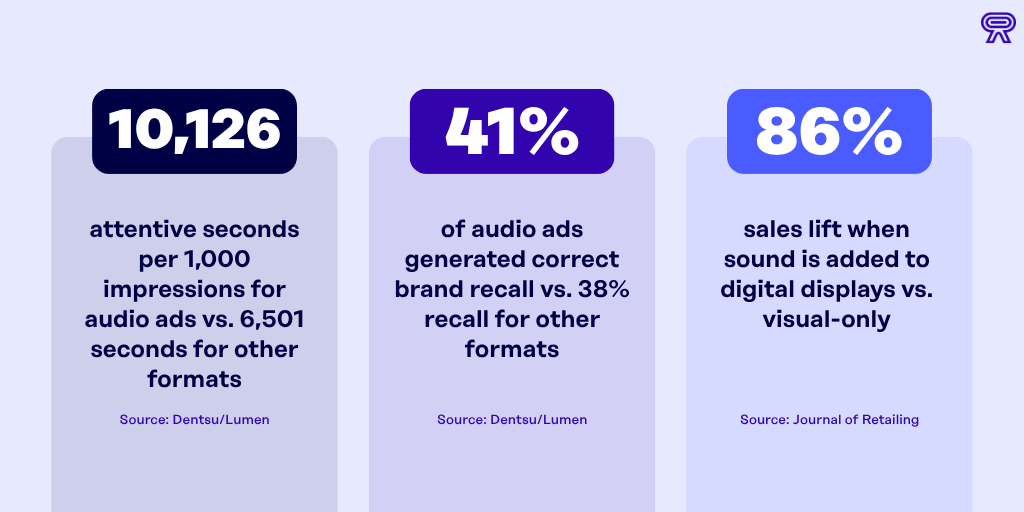
Research confirms what that test revealed. Dentsu, in partnership with Lumen and other groups, [studied consumer attention](https://lumen-research.com/blog/lumen-audio-attention-economy/) and measured the effectiveness of audio advertising (including podcasts, radio, and streaming audio):
- Audio ads averaged **10,126 attentive seconds per thousand impressions** – significantly higher than other ad formats, which averaged 6,501.
- **41% of audio ads** generated correct brand recall, compared to 38% across other formats.
- Audio delivered a **10% brand choice uplift** versus 6% for other formats – meaning listeners were more likely to choose a brand after hearing an ad.
Another study found that [adding sound to digital displays](https://www.sciencedirect.com/science/article/pii/S0022435922000446) drove an 86% sales lift compared to visual-only formats. Shoppers moving through a store are visually overloaded – packaging, promotional displays, wayfinding, and screens all compete for their attention at once. Audio cuts through the noise.
## Lesson 2: Retailers Can Turn Audio Into Ad Revenue
[Retail media ](https://info.rockbot.com/coresight-retail-media-trends-report-2026?hsLang=en)margins run over 70%– significantly higher than the products on shelves. The Journal of Retailing puts the gap even more bluntly: retail media ad margins are roughly [10 times larger](https://doi.org/10.1016/j.jretai.2025.08.005) than traditional retail margins.
Many retailers already pay for music licensing and audio infrastructure. Adding a messaging layer and selling spots within that programming to brand partners turns existing overhead into a revenue line. About 25% of the brands Rockbot works with monetize their audio airtime through third-party partner advertisements. The remaining 75% use audio only for their own promotions – and there's meaningful revenue sitting in that gap.
A district manager at a major travel and convenience retailer chain tested Rockbot audio messaging across their district and saw measurable sales lift – significant enough that corporate leadership began exploring audio across 600-plus locations.
Rockbot also works with one of the biggest retailers on their in-store retail media program. This brand reaches millions of shoppers daily and thus their RMN (retail media network) is more attractive to brand advertisers seeking scale. When leadership requested messages to run at the top of every hour, my team built and tested the solution quickly – that kind of turnaround is only possible when production is handled in-house.
## Lesson 3: Production Is Where Placements Win or Lose
An audio placement can be perfectly positioned and still underperform.
We work with a major retailer that was running retail media ads for an air freshener brand. The partnership made sense, reaching customers right at the point of purchase. But the message wasn't converting the way the retailer had hoped, so we dug in together to find out why.
The ad covered the basics, but when we listened to it in the context of an actual store environment, the problem became clear. The message was consistent with the background music's energy – it meant that it didn't pop out from the audio background in a way that grabbed attention.
This was a production problem, not a strategy problem - and we could fix it quickly. Here’s what we did within 24 hours:
Sales increased immediately. The strategy was never the problem.
We see this pattern regularly. A national outdoor retailer wasn't sure audio messaging would move the needle until they tested it during Black Friday. The results were immediate and measurable: every time an audio message played, their point-of-sale data showed corresponding conversions.
Good production means understanding how sound behaves inside a retail environment – how shoppers process audio while focused on something else, and how to engineer a message that performs in that context.
## Lesson 4: Strategy Matters as Much as the Message
Dwell time, frequency, and campaign goals all shape how audio performs in-store – and they're worth thinking through carefully.
### Know Your Dwell Time
When a major electronics retailer was preparing to launch a retail media test with Rockbot, the first thing my team wanted to understand was how long shoppers actually spent in the store. For example, if the average dwell time is 20 minutes and there are three types of messages to deliver, that determines how often each one plays.
Get this measurement wrong, and shoppers leave before hearing the right messages, or they hear the same thing too many times. A smart dwell-time calculation separates strategic audio from simply filling airtime – and it connects directly to how[customer experience](https://blog.rockbot.com/omnichannel-customer-experience-ces-2026?hsLang=en) works in practice, where in-store is one moment in a longer journey.
### Set the Right Frequency
One large retailer’s in-store retail media program is a useful benchmark. Their audio runs on a deliberate schedule – messages timed and sequenced within the broader audio environment (including custom radio) so the experience doesn't feel like an interruption.
More messages are rarely the answer. The right cadence depends on your store format, your shopper's typical path, and what you're trying to accomplish at each point in that journey.
Rockbot research from a client in the financial services sector makes this tangible: increasing customer dwell time by just one minute through strategic audio programming was able to increase Net Promoter Scores by one full point – representing $15 million in value for a major bank. Time spent in the right audio environment changes behavior.
## Lesson 5: Scale Requires Consistency – and the Right Partner
Retail media is projected to reach $203.9 billion in 2026, with physical stores still accounting for 76% of retail sales and in-store formats among the fastest-growing segments (a key [retail media trend](https://blog.rockbot.com/retail-media-trends-2026?hsLang=en) for this year).
[](https://info.rockbot.com/coresight-retail-media-trends-report-2026?hsLang=en)
The market is there and proving value in one store is the easy part. The challenge is delivering the same quality and consistency across hundreds or thousands of locations – and doing it in a way that brand partners can rely on.
That consistency matters commercially. Brand partners investing in audio placements need to know their message will sound the same in every store and perform reliably at scale. This security requires a partner who can move fast, build custom solutions, and test everything before it goes live.
[According to a Bain survey](https://www.bain.com/insights/the-store-is-striking-back-as-a-tech-enabled-space-driving-efficiency-experience-and-monetization/) of 250 top retailers, 75% of retail executives are planning a large-scale store transformation in the next two years, and 44% expect their in-store technology investments to improve their bottom line by at least 1.5 percentage points.
Retailers who build this out now will be in a stronger position as that competition grows – with better offerings for brand partners and more data to show for it.
### When We Recommend Professional Audio Production
- **Retail media partnerships:** Brand partners investing in placements expect polish and measurable results
- **Brand-critical campaigns**: Big moments deserve more than a basic voiceover
- **Multi-location scale:** Consistency across hundreds of stores requires centralized production and reliable infrastructure
- **Messages that aren’t performing:** Professional expertise can diagnose issues quickly and help fix them
## Music, Messaging, and Screens: Better Together
Screens and audio work better together than either does alone. Screens create awareness. Audio reaches shoppers while they're moving through the store, reinforcing key messages and helping close more sales.
The retailers and brand partners I work with who get the most out of their in-store media treat audio as part of the strategy from the start. That's where the results tend to show up. Getting there takes attention to detail at every level, from the strategy to the sound design.
Once, a major spice and seasonings brand flagged that a salt shaker sound effect in their spot didn't sound enough like a salt shaker. My team recorded a real shaker, cleaned the audio, and recut the spot. That level of care is just part of how we work – and it scales with your business, from 10 locations to 10,000.
If you're building out or improving an in-store retail media program, we'd love to talk. **Learn more about Rockbot's in-store** [**retail media solutions**](https://rockbot.com/retail-media) **or** [**schedule time with us.**](https://rockbot.com/contact-sales)
## Frequently Asked Questions
What Is Retail Media In-Store?
Retail media in-store refers to advertising delivered through media channels inside a physical retail location, including digital screens and audio messaging systems. These channels allow retailers to reach shoppers at the point of purchase (the moment when they're actively deciding what to buy), often using the store's existing infrastructure.
What Falls Under Retail Media?
Retail media covers advertising sold by retailers using their own first-party shopper data, across both digital and physical channels. On the digital side, this includes sponsored search placements, display ads on a retailer's app or website, and programmatic offsite advertising. In physical locations, it includes digital signage, overhead audio, and paid placements from brand partners running within a store's existing programming.
What Is Overhead Messaging?
Overhead messaging refers to promotional content delivered through a retail location's speaker system, running between or alongside background music. Retailers use it to promote their own products, announce sales, or run paid spots on behalf of brand partners. According to Rockbot data, about 25% of client retailers monetize their overhead messaging through third-party partner advertisements, while the remaining 75% use it exclusively for their own promotions.
What Is In-Store Messaging?
In-store messaging refers to audio messaging used within a physical location to communicate with shoppers during their visit. It can serve a range of purposes beyond paid advertising — guiding shoppers to a department, reinforcing a seasonal promotion, or building familiarity with a brand. According to Rockbot data, the majority of retailers using in-store messaging do so exclusively for their own brand and product promotions rather than selling placements to outside advertisers.
What Is an Example of In-Store Advertising?
An example of in-store advertising is an overhead audio spot promoting a featured product, running between songs in a store's background music programming. Other examples include a digital screen at the end of an aisle displaying a time-sensitive offer, or a brand partnership placement where a CPG company pays a retailer to run a sponsored message through the store's speaker system during peak shopping hours. In fact, these two channels work especially well in tandem – research has found that adding sound to digital displays drove [an 86% sales lift](https://www.sciencedirect.com/science/article/pii/S0022435922000446) compared to visual-only formats.

Shawn Cash, Manager, Audio Services
Author
Shawn Cash brings decades of experience in advertising, audio production, and brand storytelling to help businesses achieve the results they expect. Over the course of his career, he has hosted a highly rated radio show in a Top 25 market, programmed radio stations, launched his own successful in-store music company, and produced content for some of the world’s biggest brands. Now at Rockbot, Shawn leads the production department, bringing that expertise directly to your brand and helping you connect with customers right at the point of purchase. From global brands to local mom-and-pop shops, his experience is now in the palm of your hands as a Rockbot customer. And, by the way, he’s also a giant nerd. (It’s true.)
## Sign up for the newsletter
- Products
- [Music](https://rockbot.com/music-for-business)
- [Audio Messaging](https://rockbot.com/audio-messaging)
- [Rockbot Request](https://rockbot.com/request)
- [Digital Signage](https://rockbot.com/digital-signage-for-business)
- [Rockbot TV](https://rockbot.com/tv-for-business)
- [Music Videos](https://rockbot.com/music-videos)
- [Retail Media](https://rockbot.com/retail-media)
- [Advertising](https://rockbot.com/advertising)
- [Platform](https://rockbot.com/platform)
- [Pricing](https://rockbot.com/pricing)
- Hardware
- [Media Players & Devices](https://rockbot.com/hardware)
- [Rockbot Smart Amp](https://rockbot.com/hardware/smart-amp)
- [Rockbot Media Player](https://rockbot.com/hardware/media-player)
- [Amazon Signage Stick](https://rockbot.com/hardware/amazon-signage-stick)
- Industries
- [Retail](https://rockbot.com/retail)
- [Restaurants](https://rockbot.com/restaurants)
- [Fitness](https://rockbot.com/fitness)
- [Automotive](https://rockbot.com/automotive)
- [Bars](https://rockbot.com/bars)
- [Casinos](https://rockbot.com/casinos)
- [Corporate Offices](https://rockbot.com/corporate-offices)
- [Education](https://rockbot.com/education)
- [Entertainment Venues](https://rockbot.com/entertainment-venues)
- [Financial Services](https://rockbot.com/financial-services)
- [Grocery](https://rockbot.com/grocery)
- [Healthcare](https://rockbot.com/healthcare)
- [Hospitality](https://rockbot.com/hospitality)
- [Property Management](https://rockbot.com/property-management)
- [QSR](https://rockbot.com/qsr)
- [Salon & Spa](https://rockbot.com/salon-and-spa)
- Resources
- [Getting Started](https://support.rockbot.com/hc/en-us/categories/360000775171-Getting-Started)
- [Hardware Setup](https://rockbot.com/setup)
- [Quick Start Guides](https://support.rockbot.com/hc/en-us/sections/7705718076571)
- [Developer Portal](https://developer.rockbot.com/)
- [Request App Promo Toolkit](https://rockbot.com/request-promo-assets)
- [Help & Support](https://support.rockbot.com/hc/en-us)
- [Blog](https://blog.rockbot.com)
- [Customer Stories](https://rockbot.com/customer-stories)
- [Rockbot News](https://blog.rockbot.com/pr)
- Apps
- [Remote App](https://rockbot.com/remote-app)
- [Request App](https://rockbot.com/request-app)
- Company
- [About](https://rockbot.com/about-us)
- [Careers](https://rockbot.com/careers)
- [Contact](https://rockbot.com/contact)
- Products
- [Music](https://rockbot.com/music-for-business)
- [Audio Messaging](https://rockbot.com/audio-messaging)
- [Rockbot Request](https://rockbot.com/request)
- [Digital Signage](https://rockbot.com/digital-signage-for-business)
- [Rockbot TV](https://rockbot.com/tv-for-business)
- [Music Videos](https://rockbot.com/music-videos)
- [Retail Media](https://rockbot.com/retail-media)
- [Advertising](https://rockbot.com/advertising)
- [Platform](https://rockbot.com/platform)
- [Pricing](https://rockbot.com/pricing)
- Hardware
- [Media Players & Devices](https://rockbot.com/hardware)
- [Rockbot Smart Amp](https://rockbot.com/hardware/smart-amp)
- [Rockbot Media Player](https://rockbot.com/hardware/media-player)
- [Amazon Signage Stick](https://rockbot.com/hardware/amazon-signage-stick)
- Industries
- [Retail](https://rockbot.com/retail)
- [Restaurants](https://rockbot.com/restaurants)
- [Fitness](https://rockbot.com/fitness)
- [Automotive](https://rockbot.com/automotive)
- [Bars](https://rockbot.com/bars)
- [Casinos](https://rockbot.com/casinos)
- [Corporate Offices](https://rockbot.com/corporate-offices)
- [Education](https://rockbot.com/education)
- [Entertainment Venues](https://rockbot.com/entertainment-venues)
- [Financial Services](https://rockbot.com/financial-services)
- [Grocery](https://rockbot.com/grocery)
- [Healthcare](https://rockbot.com/healthcare)
- [Hospitality](https://rockbot.com/hospitality)
- [Property Management](https://rockbot.com/property-management)
- [QSR](https://rockbot.com/qsr)
- [Salon & Spa](https://rockbot.com/salon-and-spa)
- Resources
- [Getting Started](https://support.rockbot.com/hc/en-us/categories/360000775171-Getting-Started)
- [Hardware Setup](https://rockbot.com/setup)
- [Quick Start Guides](https://support.rockbot.com/hc/en-us/sections/7705718076571)
- [Developer Portal](https://developer.rockbot.com/)
- [Request App Promo Toolkit](https://rockbot.com/request-promo-assets)
- [Help & Support](https://support.rockbot.com/hc/en-us)
- [Blog](https://blog.rockbot.com)
- [Customer Stories](https://rockbot.com/customer-stories)
- [Rockbot News](https://blog.rockbot.com/pr)
- Apps
- [Remote App](https://rockbot.com/remote-app)
- [Request App](https://rockbot.com/request-app)
- Company
- [About](https://rockbot.com/about-us)
- [Careers](https://rockbot.com/careers)
- [Contact](https://rockbot.com/contact)
 2026 Rockbot, Inc.
- [Terms](https://rockbot.com/terms)
- [Privacy](https://rockbot.com/privacy)
- [Licensing](https://rockbot.com/licensing)
-
-
-
-
-
```json
{
"@context" : "https://schema.org",
"@type" : "BlogPosting",
"author" : {
"@type" : "Person",
"name" : "Shawn Cash, Manager, Audio Services",
"url" : "https://blog.rockbot.com/author/shawn-cash"
},
"dateModified" : "2026-09-08T11:35:31.750Z",
"datePublished" : "2026-03-10T19:10:27.000Z",
"headline" : "Lessons in In-Store Audio & Retail Media Networks | Rockbot",
"image" : [ "https://blog.rockbot.com/hubfs/Notes%20from%20the%20Field.png" ],
"mainEntityOfPage" : {
"@id" : "https://blog.rockbot.com/in-store-retail-media-and-audio",
"@type" : "WebPage"
},
"publisher" : {
"@type" : "Organization",
"logo" : {
"@type" : "ImageObject",
"url" : "https://blog.rockbot.com/hubfs/General%20Email%20Header.png"
},
"name" : "Rockbot"
}
}
```