



Most retail sales in the U.S. still happen in physical stores. Whereas 18.5% of these sales are considered e-commerce, 81.5% are attributed to brick-and-mortar locations. With so much revenue flowing through physical locations, why has retail media focused predominantly on digital channels? And why is in-store retail media making such strong inroads now? Retail media measurement is a key factor, determining how the partnership between retailers and brand advertisers will evolve.
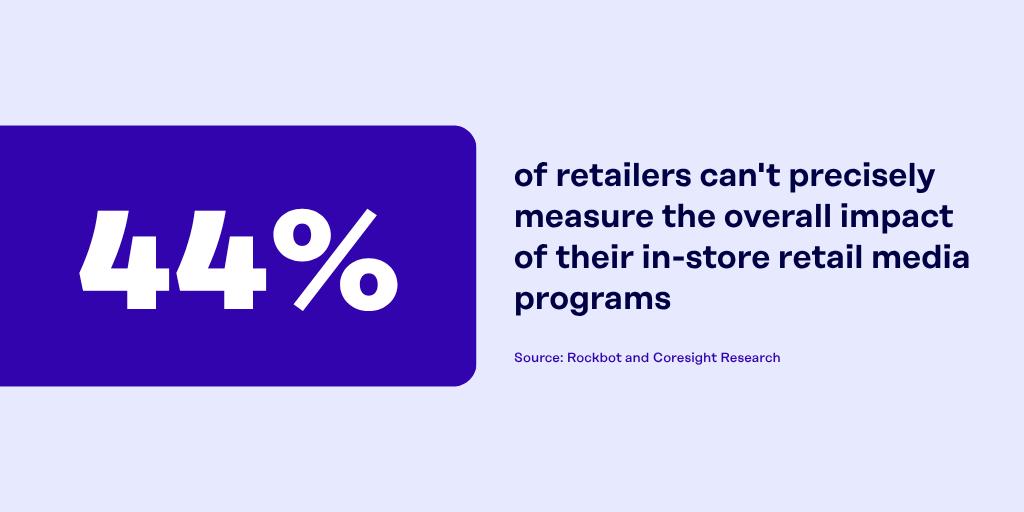
Rockbot recently partnered with Coresight Research to survey 250 U.S. retail executives on in-store retail media, with a focus on the analytical challenges retailers face. The data shows that 44% of retailers can't measure the overall impact of their in-store programs. And in a market growing at 14% YoY, the retailers that close that gap first will have a structural advantage over everyone else.
What Is Retail Media Measurement – and Why Does It Matter?
Retail media measurement is the process of tracking, attributing, and proving the business impact of advertising within a retailer's owned media environment – including in-store screens, audio, and digital signage. For in-store retail media specifically, measurement helps connect an ad impression to a shopper action: did the message reach someone, and did it change their behavior?
Unlike digital channels, where clicks and conversions are tracked automatically, in-store retail media measurement requires intentional infrastructure: the ability to verify that an ad played, that a shopper was present, and that a sale followed. Without that foundation, retailers can't compete for brand advertising budgets that increasingly demand proof of performance.
Rockbot's view: Measurement gaps have a direct impact on revenue. Retailers that can prove results attract more brand advertising dollars. Those who can't leave money on the table. The data from this report points to a clear inflection point, and the window to build a structural advantage is now.
Retail Media Measurement: Gaps On All Sides
In-store retail media is gaining momentum, with 98% of survey respondents prioritizing it either moderately or strongly. Further, 97% of retail leaders said they are currently investing in scaling in-store retail media capabilities. This enthusiasm mirrors broader industry trends, with in-store retail media’s share of overall retail media revenues expected to grow by 23% over the next year.
While retailers are dedicated to growing and improving this capacity, leaders report challenges, likely caused by structural gaps – when swift deployment was prioritized over long-term analytics. Among surveyed retailers, nearly half (44%) report difficulties measuring the overall impact of in-store retail media, with the biggest contributors being:
-
55% can’t track shopper movement in stores
-
52% can’t capture ad exposure
-
49% have limited use of AI to understand shopper behavior
The two most cited issues are fundamental to the Interactive Advertising Bureau’s (IAB) new in-store retail media measurement framework, which includes three foundational layers deemed essential to accurate data: Verified Impressions (did the ad play and was a shopper present?), Audience + Context (who saw it, when, and where?), and Outcomes (did it drive a sale?). Without the ability to track shopper movement and capture ad exposure, retailers can't meet even the framework's baseline requirements.
The measurement gap isn't just an analytics problem. Fifty-eight percent of retailers cite fragmented technology infrastructure as a moderate-to-significant challenge, and 52% say a lack of integration with existing systems – such as point-of-sale and content management – compounds the problem.
When screens, audio, and data systems aren't connected, measurement becomes structurally difficult before it even becomes a strategic choice. Forty-nine percent of retailers also identify cross-function collaboration as a barrier, meaning the problem is as much organizational as it is technical. And the consequences show up in scale: despite ranking lower overall than infrastructure costs and fragmentation, ineffective performance measurement ranks third when weighted by severity, with 23% of retailers saying it is significantly impacting their organization.
Problems with data confidence aren’t limited to the retailer side – 53% of retail media executives say they aren’t confident their own measurement reflects true incrementality (i.e., did this ad actually cause the sale, or would the customer have bought anyway?). In fact, the scale of the problem is industry-wide. According to McKinsey, only 3% of advertising decision-makers say commerce media networks (inclusive of retail media) measure audience incrementality very accurately.
In-Store Retail Media Analytics: The Measurement Gap Advertisers Already See
Many retailers are capturing data that doesn’t tell the full story. The most widely used methods for assessing results – cross-channel sales impact (62%) and in-store movement tracking (61%) – focus on the bottom of the funnel. However, according to our report data, brand building is now the #1 advertiser objective. And the methods that can prove brand outcomes aren’t being used as frequently:
-
Brand recall or awareness studies: 44%
-
Social media sentiment tracking: 41%
-
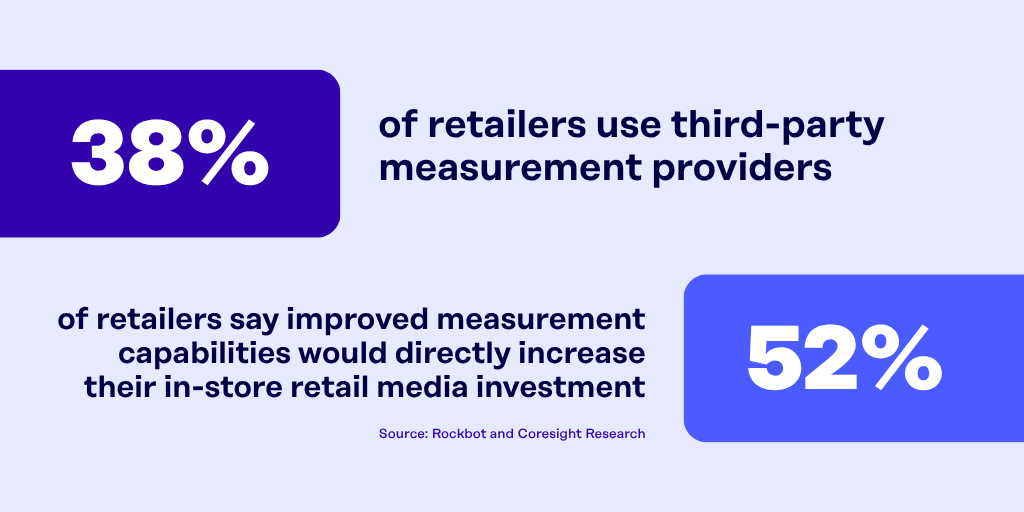
Third-party measurement providers: 38%
Retailers are measuring the bottom of the funnel while advertisers are increasingly focused on the top. That misalignment is a revenue risk. Further, only 38% of retailers currently use third-party measurement providers – despite independent validation from vendors like Nielsen, Circana, and Comscore being one of the clearest ways to give advertisers confidence in reported results. For in-store retail media to compete seriously with more established channels, that number needs to grow.
Kroger Precision Marketing's PrecisionView 360 offers a concrete example of what closing that gap looks like in practice. Rather than relying on traditional attribution models that assign credit to purchases that may have happened anyway, PrecisionView 360 uses test and control groups to isolate the real impact of media exposure – measuring the difference in purchase behavior between shoppers who saw ads and those who didn't, across both in-store and online channels. The result is a clearer picture of which media actually drove sales.
Measurement Is a Growth Strategy
Among surveyed retail leaders, 52% say improved measurement capabilities would directly increase their in-store retail media investment. The bulk of the $203.9B retail media market is still focused on digital – that’s where brand advertising dollars are because results are better proven and trusted.
In-store can compete for that budget if retailers can show the same quality of proof. The retailers investing in measurement infrastructure today will also have a head start that's hard to replicate: a year or two of data history that late movers simply can't quickly catch up to.
That's where incrementality becomes a competitive advantage. A retailer that can show an ad that drove sales that wouldn't have happened otherwise can have a fundamentally different conversation with a brand advertiser than one that can only show that sales happened.
-
djklfdj
- djfkldkf
The importance of trustworthy data holds true across all types of RMNs. ADOTAT's analysis of the retail media landscape points to a consistent pattern: the brands gaining share have solved for incrementality, while those optimizing for surface-level metrics are not. Notably, the CFOs approving budget increases are specifically the ones who have seen rigorous tests prove real business impact.
A Harvard Business Review study of 28 executives with a combined revenue of $1.1T showed similar results. Researchers found that retailers who quantify incremental sales consistently earn long-term advertiser participation, whereas those relying on impressions and CTR are losing ground.
The Path Forward: How Retailers Can Pull Ahead
The path forward is concrete. Rockbot and Coresight Research survey data points to three moves that separate the programs pulling ahead from the ones stalling out – and each one builds directly on the last:
-
Fix the foundation first. Shopper movement tracking, dwell time, and ad exposure capture are the basics – and the exact capabilities the IAB framework requires before anything more sophisticated can work.
-
Align to IAB standards now, even imperfectly. Advertisers are starting to ask for reporting that follows IAB standards. Getting there early creates a common language with brand partners that latecomers won't have.
-
Treat measurement as a long-term asset. Incrementality testing is only meaningful when there's a baseline to measure against. The sooner that data starts accumulating, the better.
The retailers that build measurement foundations now are best positioned to capture a disproportionate share of budget as the market matures. According to the IAB's State of Data 2026, improved measurement accuracy could unlock between $14.5 and $26.3 billion in media investment within one to two years. Increasingly, the retailers that get more brand advertising dollars will be the ones that can show exactly what those dollars did.
Rockbot’s retail media solution connects in-store screens, audio, and analytics into a unified platform – so measurement is built into your program from day one, not retrofitted after the fact. Retailers using a unified platform build the kind of proof that turns a good in-store program into a preferred destination for brand advertising dollars.
The data in this post comes from "Retail Media Intelligence: Unlocking the Power of In-Store Retail Media," created by Rockbot in partnership with Coresight Research. The full report goes further into how Walmart and Kroger approach in-store media, a maturity model that shows where most programs stall, and strategic implications for retailers and technology vendors.
Download the report to see where your program stands – and what it takes to pull ahead.