---
title: Background Music for Restaurants 101 Guide | Rockbot
description: The right restaurant background music shapes the customer experience and supports your business goals. Here’s how to choose, schedule, and manage it well.
image: https://blog.rockbot.com/hubfs/Restaurant%20Background%20Music.jpg
---
[](https://rockbot.com)
- Products
## Audio
Control everything customers hear in your business
- [ Music Deliver your ideal sound](https://rockbot.com/music-for-business)
- [ Audio Messaging Amplify your brand’s voice](https://rockbot.com/audio-messaging)
- [ Rockbot Request Let guests be the DJ](https://rockbot.com/request)
## [Retail Media Monetize your in‑store media with audio and visual ads Learn More](https://rockbot.com/retail-media)
## Video
Manage all aspects of visual media in your business
- [ Digital Signage Bring your location to life](https://rockbot.com/digital-signage-for-business)
- [ Rockbot TV Captivate your audience](https://rockbot.com/tv-for-business)
- [ Music Videos Top artists on your screens](https://rockbot.com/music-videos)
## [Advertise with us Reach your audience through premium, out-of-home multi-media ads Learn More](https://rockbot.com/advertising)
## [Media Players & Devices Power your business media with reliable, scalable hardware Explore](https://rockbot.com/hardware)
- Industries
## Industries
Smarter media solutions built for your business
- [Retail](https://rockbot.com/retail)
- [Restaurants](https://rockbot.com/restaurants)
- [Fitness](https://rockbot.com/fitness)
- [Automotive](https://rockbot.com/automotive)
- [Bars](https://rockbot.com/bars)
- [Casinos](https://rockbot.com/casinos)
- [Corporate Offices](https://rockbot.com/corporate-offices)
- [Education](https://rockbot.com/education)
- [Entertainment Venues](https://rockbot.com/entertainment-venues)
- [Financial Services](https://rockbot.com/financial-services)
- [Grocery](https://rockbot.com/grocery)
- [Healthcare](https://rockbot.com/healthcare)
- [Hospitality](https://rockbot.com/hospitality)
- [Property Management](https://rockbot.com/property-management)
- [QSR](https://rockbot.com/qsr)
- [Salon & Spa](https://rockbot.com/salon-and-spa)
- Resources
## Explore Rockbot
Stories, insights, and the team behind the platform
- [Customer Stories](https://rockbot.com/customer-stories)
- [Rockbot Blog](https://blog.rockbot.com/)
- [About Us](https://rockbot.com/about-us)
## Getting Started
Everything you need to get started
- [Hardware Setup](https://rockbot.com/hardware/setup)
- [Quick Start Guides](https://support.rockbot.com/hc/en-us/sections/7705718076571)
- [Help & Support](https://support.rockbot.com/hc/en-us)
- [Developer Portal](https://developer.rockbot.com/)
- [Pricing](https://rockbot.com/pricing)
[Login](https://rockbot.com/login) [Contact Sales](https://rockbot.com/contact-sales)
[Login](https://rockbot.com/login) [Contact Sales](https://rockbot.com/contact-sales)
- Products
## Audio
Control everything customers hear in your business
- [ Music Deliver your ideal sound](https://rockbot.com/music-for-business)
- [ Audio Messaging Amplify your brand’s voice](https://rockbot.com/audio-messaging)
- [ Rockbot Request Let guests be the DJ](https://rockbot.com/request)
## [Retail Media Monetize your in‑store media with audio and visual ads Learn More](https://rockbot.com/retail-media)
## Video
Manage all aspects of visual media in your business
- [ Digital Signage Bring your location to life](https://rockbot.com/digital-signage-for-business)
- [ Rockbot TV Captivate your audience](https://rockbot.com/tv-for-business)
- [ Music Videos Top artists on your screens](https://rockbot.com/music-videos)
## [Advertise with us Reach your audience through premium, out-of-home multi-media ads Learn More](https://rockbot.com/advertising)
## [Media Players & Devices Power your business media with reliable, scalable hardware Explore](https://rockbot.com/hardware)
- Industries
## Industries
Smarter media solutions built for your business
- [Retail](https://rockbot.com/retail)
- [Restaurants](https://rockbot.com/restaurants)
- [Fitness](https://rockbot.com/fitness)
- [Automotive](https://rockbot.com/automotive)
- [Bars](https://rockbot.com/bars)
- [Casinos](https://rockbot.com/casinos)
- [Corporate Offices](https://rockbot.com/corporate-offices)
- [Education](https://rockbot.com/education)
- [Entertainment Venues](https://rockbot.com/entertainment-venues)
- [Financial Services](https://rockbot.com/financial-services)
- [Grocery](https://rockbot.com/grocery)
- [Healthcare](https://rockbot.com/healthcare)
- [Hospitality](https://rockbot.com/hospitality)
- [Property Management](https://rockbot.com/property-management)
- [QSR](https://rockbot.com/qsr)
- [Salon & Spa](https://rockbot.com/salon-and-spa)
- Resources
## Explore Rockbot
Stories, insights, and the team behind the platform
- [Customer Stories](https://rockbot.com/customer-stories)
- [Rockbot Blog](https://blog.rockbot.com/)
- [About Us](https://rockbot.com/about-us)
## Getting Started
Everything you need to get started
- [Hardware Setup](https://rockbot.com/hardware/setup)
- [Quick Start Guides](https://support.rockbot.com/hc/en-us/sections/7705718076571)
- [Help & Support](https://support.rockbot.com/hc/en-us)
- [Developer Portal](https://developer.rockbot.com/)
- [Pricing](https://rockbot.com/pricing)
[Login](https://rockbot.com/login) [Contact Sales](https://rockbot.com/contact-sales)
# Background Music for Restaurants 101
Last updated | September 8, 2026
 Rachel Mindell, Strategic Content Marketing Manager

[Rachel Mindell, Strategic Content Marketing Manager](https://blog.rockbot.com/author/rachel-mindell-1)
##### Share
- [**](https://www.linkedin.com/shareArticle?mini=true&url={url}&title={title})
- [**](https://www.facebook.com/sharer.php?u={url})
- [**](https://twitter.com/intent/tweet?url={url}&text={title})
Table of Contents ▾
### Table of Contents
### Key Takeaways
- **Music is brand infrastructure:** The right background music shapes how guests feel, how long they stay, and whether they come back – treat it like lighting or service, not an afterthought.
- **Match the music to the moment:** A playlist that works at lunch may not work at dinner. Your sound should evolve through the day just as the energy in the room does.
- **Every concept sounds different:** Fine dining, fast casual, and family restaurants all need fundamentally different sound programs – there's no universal playlist that works every concept.
- **Licensing isn't optional:** Personal streaming apps aren't legal for commercial use, and the fines aren't worth it. Choose a solution that can help you with licensing for business music streaming.
- **Hardware matters more than most realize:** Your amp, speakers, and media player determine whether your sound program actually holds up across your space and locations.
Music evokes emotions, and emotion is the most vital component of customer experience. Two restaurants can serve similar food at comparable prices, but the one with the right atmosphere wins on repeat visits. Music is part of your atmosphere and brand infrastructure, like lighting or decorations; it sends a signal about who you are and who you're for. The best restaurant background music goes completely unnoticed – and guests only mention it when something is wrong.
The research backs this up, since tempo alone has been proven to measurably affect table turnover. [Studies show](https://pmc.ncbi.nlm.nih.gov/articles/PMC11673941) that slow-tempo music increases the time customers spend at a table, while fast-tempo music shortens it. Interestingly, eating in complete silence actually makes people finish faster than with any music at all. Even the texture of the music matters: smooth, legato tracks create the longest dwell times.
Given the significance of great sound, let’s dig into the key components of a successful restaurant background music program.
## Choosing Background Music by Restaurant Type
There's no universal playlist that works for every restaurant. The right background music depends entirely on your concept, clientele, and what you're hoping visitors will feel. Here's a practical breakdown by environment.
### Fine Dining
Guests seek out fine dining for elevated dishes, impeccable service, and a chance to hear each other talk. Your music exists to enhance that, not compete with it.
**What works:** Jazz, classical, or contemporary instrumental. Think Miles Davis during dinner service, not Top 40.
**Energy level:** Low and unhurried. You want guests to relax, settle in, and order another bottle of wine.
Choosing instrumental music is also supported by [cognitive research](https://pmc.ncbi.nlm.nih.gov/articles/PMC12627320), which shows that music with lyrics creates a "cognitive bottleneck" – it competes with conversation, making it harder for guests to focus on the people they're with.
### Casual Dining and Cafés
**What works:** Acoustic indie, folk, soft rock, or light pop. Choose music that is inviting and comfortable without being aggressive.
**Energy level:** Medium. Fill the room without taking it over.
### Fast Casual and QSR
**What works:** Upbeat contemporary pop, indie-pop, or high-energy playlists. You'll want to keep the rhythm brisk.
**Energy level:** Higher, especially during the lunch rush.
Fast-tempo music also has a measurable effect on buying behavior: [research in consumer psychology](https://doi.org/10.3389/fpsyg.2023.1236006) found that it increases variety-seeking. For example, customers are more likely to try new items or add on to their order. One caveat is that this effect only holds if the music is familiar to the listener – obscure tracks don't trigger the same response.
### Bars and Lounges
**Important:** If your bar and dining areas have different vibes (which they often do), you’ll want two separate audio streams.
**Energy level:** Build gradually from chill to energetic as the night progresses.
### Family-Friendly Restaurants
Appropriate music is vital for family-friendly environments. Rockbot offers lyric filtering in the [music dashboard](https://rockbot.com/music-for-business), with rating systems for Instrumental, PG, PG-13, and R lyrics. Ensuring the music is right will help keep these spaces family-friendly and comfortable for all ages.
## Timing Your Music Throughout the Day
Your restaurant at 11 AM is a different space than it is at 9 PM. Likewise, your background music should evolve and progress throughout the day – otherwise known as dayparting. Here's how to treat it as an operational tool that shifts with your service.
### Breakfast and Lunch
Earlier in the day, keep sound light enough for easy conversation. Music should fill silence without fighting for attention – think background, not foreground. If you need tables to turn faster at peak hours, [behavioral research](https://pubmed.ncbi.nlm.nih.gov/32682852) suggests leaning toward slightly faster tempos that naturally encourage a brisker pace without guests realizing why.
### Happy Hour
People come to Happy Hour after work. They're likely decompressing and socializing – ideally, they stay for another drink. Program background music that is lively but not overwhelming; the room is warming up, not peaked yet.
### Dinner Service
This is prime time. Music needs to support the experience you're selling.
- Fine dining: Smooth and sophisticated, unhurried
- Casual dining: Familiar and comfortable, not distracting
- Bar-forward spots: Building energy, setting the stage for late night
### Late Night
Late nights invite more energy and slightly higher volume – this is when to let the playlist breathe. With the [Rockbot Request App](https://rockbot.com/request-app), you can allow guests to request songs from their phones while you stay in control of what actually plays.
## Practical Tips for Restaurant Sound Scheduling
Good scheduling turns a solid playlist into a seamless guest experience. Once your music is dialed in by daypart, these two habits will keep it running smoothly:
- **Build playlists that are at least 4–6 hours long.** Your staff will eventually grow tired of shorter playlists and notice the repetition over a number of hours and days, so keep the playlists longer and refresh them consistently.
- **Aim for smooth transitions.** If you're moving from mellow dinner music to upbeat evening vibes, make the change gradual. This will result in a much more pleasant and well-paced experience.
- **Bring in resources.** Looking for recommendations or news ideas? Rockbot provides hundreds of exclusive playlists and expert Music Curators who offer [services such as regular playlist refreshes](https://rockbot.com/professional-content-services).
In the Rockbot music dashboard, you can easily and intuitively [schedule restaurant sound](https://rockbot.com/music-scheduling) – you can even program several playlists and set the time of day you want them to play.
## Getting Set Up: Platforms, Licensing, and Tools
The setup side of restaurant music covers a few distinct areas: licensing, the right solution, and hardware. Get these right from the start, and everything else is easier.
### The Licensing Reality
When it comes to background music streamlining, there are specific rules set by performing rights organizations, or PROs, to protect artists. In the U.S., in order to play any music from any source in a public business establishment, business owners need licenses from four PROs (ASCAP, BMI, SESAC, and GMR).
For example, you cannot legally stream music from Spotify, Apple Music, or YouTube in your restaurant. Those platforms are for personal use only, and using them commercially exposes you to fines. Commercial music platforms, like Rockbot, [handle licensing](https://rockbot.com/licensing) for streaming music, so you don't have to think about it. If you have host music, DJs, or karaoke, you’ll need to explore licensing beyond Rockbot.
### Background Music Solutions for Restaurants
Not all streaming music solutions are built for hospitality. Here's what actually matters when you're evaluating your options:
- **Fully licensed music:** Non-negotiable
- **Multi-location control:** If you're managing more than one spot, a centralized dashboard saves time
- **Scheduling features:** Set different playlists for different times without manual switching
- **Zone management:** Play different music in the bar and dining room
- **Playlist import:** Rockbot enables users to import playlists from their personal DSP accounts with Spotify and Apple Music into the Rockbot music dashboard, making them commercially legal
- **Media integration:** If you're running digital signage or TVs, a unified dashboard helps you manage music and everything else from one place
Rockbot offers all of these features along with music curation, video curation, audio services, and digital signage services.
### Hardware Considerations
The right [restaurant sound system](https://blog.rockbot.com/restaurant-sound-systems?hsLang=en) can make all the difference for customer experience. The core components are an amplifier, speakers, and a media player.
Speaker placement and amplifier size depend on your footprint – most restaurants under 5,000 square feet need just one commercial-grade 70-volt amp to cover the room. The media player is equally important: personal streaming apps like Spotify weren't designed for commercial use, and the gaps show up in licensing exposure, volume inconsistency, and playlists that don't reflect your brand.
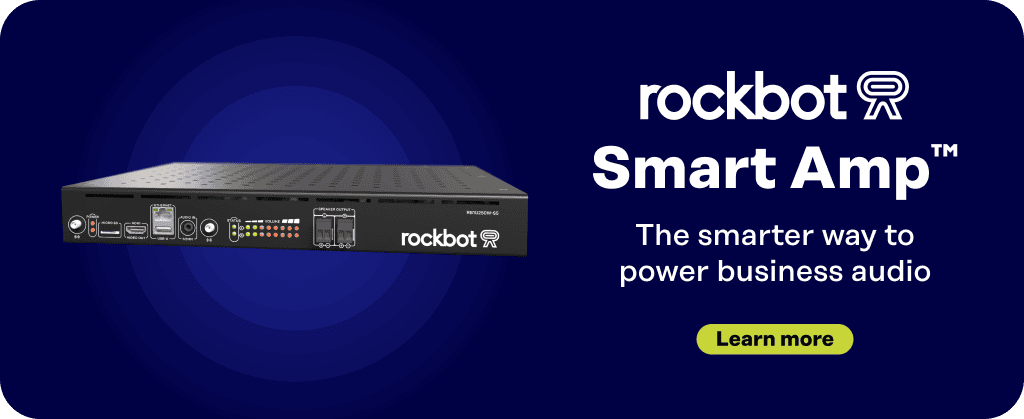
Round out the setup with reliable internet and a centralized dashboard, and you have a complete sound system – though managing those components separately has its own overhead. The [Rockbot Smart Amp™](https://rockbot.com/hardware/smart-amp) consolidates your amplifier and media player into a single, software-managed unit – fewer failure points, remote visibility across locations, and tamper-proof controls with no knobs or dials for staff to adjust.
[](https://rockbot.com/hardware/smart-amp)
The Smart Amp supports all common speaker types, handles two independent volume zones, and receives ongoing updates through the Rockbot platform – no hardware swap required.
Whether you go with an all-in-one solution or build your own stack, the principle is the same: your hardware should make it easier to maintain consistency across your space, not harder.
## Common Sound Mistakes to Avoid
While every restaurant is different, the following missteps are common:
- **Playing unlicensed music:** The fines aren't worth it. Commercial platforms like Rockbot offer fully licensed music to keep you compliant.
- **Playlists that repeat too often:** Your staff hears the music all shift, every shift. A 2-hour loop is a morale problem. Aim for 4-6 hours minimum and refresh regularly.
- **Setting it and forgetting it:** Playlists get stale. Update seasonally and adjust based on the holidays your business observes.
- **Getting volume wrong:** Too loud and guests can't hear each other; too quiet and there's no atmosphere. For multi-location operators, volume is also a brand consistency and compliance issue – calibrate the right level per location and set a ceiling that staff can't override.
- **Same playlist from open to close:** Lunch and dinner are different experiences. Your music should reflect that shift in energy and mood.
- **Generic playlists that don't reflect your brand:** Your playlist should feel like it belongs specifically in your space and elevates your brand image. Playlists should feel fresh and unique to your restaurant.
- **Not planning for scale:** Cobbling together different solutions per location creates operational headaches. Think about scalability from the start – a good solution works as well across a hundred locations as it does across one.
## Hear the Difference in Your Restaurant
Music shapes your restaurant in ways most guests will never consciously notice – and that's exactly the point. Rockbot makes it easy to get sound perfectly right: fully licensed music, smart scheduling, remote control across every location, and hardware built for commercial use.
[Talk to a team specialist](https://rockbot.com/contact-sales) or learn more about [Rockbot for restaurants](https://rockbot.com/restaurants).
Thanks to Rockbot Music Curator Khushi Ramlogun for her collaboration on this article.
## Frequently Asked Questions
What Is the Best Music for a Restaurant?
The best music for a restaurant depends entirely on your concept and clientele. Whereas a fine-dining room calls for something smooth and unobtrusive (jazz or contemporary instrumental), a fast-casual spot benefits from upbeat pop that keeps energy high. The common thread is that the best restaurant music goes completely unnoticed by guests; they feel it without registering it.
Why Do Most Restaurants Have Background Music?
Most restaurants have background music because it directly shapes the guest experience. Music fills the room, masks kitchen noise, and gives guests something to settle into. Even [research shows](https://www.mdpi.com/2076-328X/14/12/1188) that sound impacts customers, with slow-tempo music increasing the time customers spend at a table and fast-tempo music shortening it.
What Music Attracts Customers?
Music that attracts customers is appropriate to the setting and consistent with the overall brand experience. Familiar tracks tend to outperform obscure ones – according to [consumer research](https://www.frontiersin.org/journals/psychology/articles/10.3389/fpsyg.2023.1236006/full), unfamiliar music doesn't trigger the same positive response in buying behavior. The ultimate goal for any business should be overhead music that feels like it belongs in your specific space.
Do I Need a Music License to Play Music in My Restaurant?
Yes, playing music in a restaurant requires a commercial license regardless of the source. In the U.S., that means obtaining licenses from four performing rights organizations: ASCAP, BMI, SESAC, and GMR. Commercial music platforms like Rockbot handle licensing for streaming music on your behalf, so you don't have to manage it separately.
What Music Can I Play in My Restaurant?
With the right licensing in place, you can play virtually any commercially available music in your restaurant. The more practical question is what you should play, which comes down to your concept, your daypart, and your guests. A dedicated business music platform gives you a fully licensed library plus the scheduling and curation tools to make those decisions easy.

Rachel Mindell, Strategic Content Marketing Manager
Author
Rachel Mindell leads content ideation and execution across channels at Rockbot, with a focus on creating lasting value for clients and prospects via commercial in-location media. Based in Tucson, Arizona, she's also a singer, book nerd, and fitness enthusiast who loves getting out in nature.
## Sign up for the newsletter
- Products
- [Music](https://rockbot.com/music-for-business)
- [Audio Messaging](https://rockbot.com/audio-messaging)
- [Rockbot Request](https://rockbot.com/request)
- [Digital Signage](https://rockbot.com/digital-signage-for-business)
- [Rockbot TV](https://rockbot.com/tv-for-business)
- [Music Videos](https://rockbot.com/music-videos)
- [Retail Media](https://rockbot.com/retail-media)
- [Advertising](https://rockbot.com/advertising)
- [Platform](https://rockbot.com/platform)
- [Pricing](https://rockbot.com/pricing)
- Hardware
- [Media Players & Devices](https://rockbot.com/hardware)
- [Rockbot Smart Amp](https://rockbot.com/hardware/smart-amp)
- [Rockbot Media Player](https://rockbot.com/hardware/media-player)
- [Amazon Signage Stick](https://rockbot.com/hardware/amazon-signage-stick)
- Industries
- [Retail](https://rockbot.com/retail)
- [Restaurants](https://rockbot.com/restaurants)
- [Fitness](https://rockbot.com/fitness)
- [Automotive](https://rockbot.com/automotive)
- [Bars](https://rockbot.com/bars)
- [Casinos](https://rockbot.com/casinos)
- [Corporate Offices](https://rockbot.com/corporate-offices)
- [Education](https://rockbot.com/education)
- [Entertainment Venues](https://rockbot.com/entertainment-venues)
- [Financial Services](https://rockbot.com/financial-services)
- [Grocery](https://rockbot.com/grocery)
- [Healthcare](https://rockbot.com/healthcare)
- [Hospitality](https://rockbot.com/hospitality)
- [Property Management](https://rockbot.com/property-management)
- [QSR](https://rockbot.com/qsr)
- [Salon & Spa](https://rockbot.com/salon-and-spa)
- Resources
- [Getting Started](https://support.rockbot.com/hc/en-us/categories/360000775171-Getting-Started)
- [Hardware Setup](https://rockbot.com/setup)
- [Quick Start Guides](https://support.rockbot.com/hc/en-us/sections/7705718076571)
- [Developer Portal](https://developer.rockbot.com/)
- [Request App Promo Toolkit](https://rockbot.com/request-promo-assets)
- [Help & Support](https://support.rockbot.com/hc/en-us)
- [Blog](https://blog.rockbot.com)
- [Customer Stories](https://rockbot.com/customer-stories)
- [Rockbot News](https://blog.rockbot.com/pr)
- Apps
- [Remote App](https://rockbot.com/remote-app)
- [Request App](https://rockbot.com/request-app)
- Company
- [About](https://rockbot.com/about-us)
- [Careers](https://rockbot.com/careers)
- [Contact](https://rockbot.com/contact)
- Products
- [Music](https://rockbot.com/music-for-business)
- [Audio Messaging](https://rockbot.com/audio-messaging)
- [Rockbot Request](https://rockbot.com/request)
- [Digital Signage](https://rockbot.com/digital-signage-for-business)
- [Rockbot TV](https://rockbot.com/tv-for-business)
- [Music Videos](https://rockbot.com/music-videos)
- [Retail Media](https://rockbot.com/retail-media)
- [Advertising](https://rockbot.com/advertising)
- [Platform](https://rockbot.com/platform)
- [Pricing](https://rockbot.com/pricing)
- Hardware
- [Media Players & Devices](https://rockbot.com/hardware)
- [Rockbot Smart Amp](https://rockbot.com/hardware/smart-amp)
- [Rockbot Media Player](https://rockbot.com/hardware/media-player)
- [Amazon Signage Stick](https://rockbot.com/hardware/amazon-signage-stick)
- Industries
- [Retail](https://rockbot.com/retail)
- [Restaurants](https://rockbot.com/restaurants)
- [Fitness](https://rockbot.com/fitness)
- [Automotive](https://rockbot.com/automotive)
- [Bars](https://rockbot.com/bars)
- [Casinos](https://rockbot.com/casinos)
- [Corporate Offices](https://rockbot.com/corporate-offices)
- [Education](https://rockbot.com/education)
- [Entertainment Venues](https://rockbot.com/entertainment-venues)
- [Financial Services](https://rockbot.com/financial-services)
- [Grocery](https://rockbot.com/grocery)
- [Healthcare](https://rockbot.com/healthcare)
- [Hospitality](https://rockbot.com/hospitality)
- [Property Management](https://rockbot.com/property-management)
- [QSR](https://rockbot.com/qsr)
- [Salon & Spa](https://rockbot.com/salon-and-spa)
- Resources
- [Getting Started](https://support.rockbot.com/hc/en-us/categories/360000775171-Getting-Started)
- [Hardware Setup](https://rockbot.com/setup)
- [Quick Start Guides](https://support.rockbot.com/hc/en-us/sections/7705718076571)
- [Developer Portal](https://developer.rockbot.com/)
- [Request App Promo Toolkit](https://rockbot.com/request-promo-assets)
- [Help & Support](https://support.rockbot.com/hc/en-us)
- [Blog](https://blog.rockbot.com)
- [Customer Stories](https://rockbot.com/customer-stories)
- [Rockbot News](https://blog.rockbot.com/pr)
- Apps
- [Remote App](https://rockbot.com/remote-app)
- [Request App](https://rockbot.com/request-app)
- Company
- [About](https://rockbot.com/about-us)
- [Careers](https://rockbot.com/careers)
- [Contact](https://rockbot.com/contact)
 2026 Rockbot, Inc.
- [Terms](https://rockbot.com/terms)
- [Privacy](https://rockbot.com/privacy)
- [Licensing](https://rockbot.com/licensing)
-
-
-
-
-
```json
{
"@context" : "https://schema.org",
"@type" : "BlogPosting",
"author" : {
"@type" : "Person",
"name" : "Rachel Mindell, Strategic Content Marketing Manager",
"url" : "https://blog.rockbot.com/author/rachel-mindell-1"
},
"dateModified" : "2026-09-08T11:30:21.202Z",
"datePublished" : "2013-10-29T00:46:00.000Z",
"headline" : "Background Music for Restaurants 101 Guide | Rockbot",
"image" : [ "https://blog.rockbot.com/hubfs/Restaurant%20Background%20Music.jpg" ],
"mainEntityOfPage" : {
"@id" : "https://blog.rockbot.com/blog/background-music-for-restaurants",
"@type" : "WebPage"
},
"publisher" : {
"@type" : "Organization",
"logo" : {
"@type" : "ImageObject",
"url" : "https://blog.rockbot.com/hubfs/General%20Email%20Header.png"
},
"name" : "Rockbot"
}
}
```