




As a business operator, you probably know how important licensed music is to your locations. Or perhaps you’ve received outreach from an organization called ASCAP, BMI, SESAC, or GMR saying that your business owes money for the music you play.
According to federal law, in order to play any music from any source in a public business establishment, business owners must have licensed permission from the owners of the copyrighted music being played.
In the U.S., that permission for songwriters' music is granted through four performing rights organizations, or PROs: ASCAP, BMI, SESAC, and GMR. Because the artists and songwriters who create that music are entitled to fair compensation for their work, PROs work to make sure they receive it.
Each of these PROs represents a large catalog of songwriters (but not all songwriters), so most businesses need licenses from all four to have full coverage for the music they play.
So, what does this mean for your business? While the fundamentals of music licensing apply across all commercial settings, specific requirements vary by industry.
Restaurants and bars, for example, have different considerations than fitness studios. Below, you'll find the essential licensing requirements all businesses share, with notes on where industry-specific factors come into play.
Please note: This guide is for informational purposes only and does not constitute legal advice. For questions specific to your business, consult a qualified attorney or music rights professional.
Why Music Licensing Exists
When you listen to a song, you're hearing two distinct pieces of intellectual property: the musical composition (the melodies, harmonies, and lyrics a songwriter creates) and the sound recording (the specific recorded performance of that song). These are two separate copyrights, and they are usually owned by two entirely different parties.
Public performance rights under U.S. copyright law cover any time you play music out loud in your business establishment. This applies whether music is central to your business or simply playing in the background. Customers don't need to be actively listening for the requirement to apply.
The law is straightforward: playing copyrighted music publicly in a commercial space requires licensed permission from the copyright owners.
Just as your business earns revenue when customers make a purchase, recording artists and songwriters earn compensation when their music is performed publicly in a commercial setting.
The Four U.S. Performing Rights Organizations
ASCAP
ASCAP (the American Society of Composers, Authors, and Publishers) is the oldest PRO in the United States, founded in 1914. ASCAP represents over one million songwriters, composers, and music publishers, and its catalog spans virtually every genre of popular music.
ASCAP operates on an open membership model, meaning any songwriter or publisher can apply to join. For businesses, ASCAP offers blanket licenses – a single annual fee that covers access to ASCAP's entire catalog, rather than requiring a separate license for each song. ASCAP is subject to a federal antitrust consent decree, which requires it to license to any applicant and to use a federal rate court to resolve royalty disputes rather than resorting to copyright litigation.
ASCAP's rate schedules vary based on factors like business type, square footage, and how music is being used.
BMI
BMI (Broadcast Music, Incorporated) was founded in 1939, in part as an open-membership alternative to ASCAP. BMI represents more than one million songwriters and composers and covers over 22 million musical works. Together, ASCAP and BMI represent the vast majority of songwriters in the United States.
Like ASCAP, BMI offers blanket licenses and is subject to a federal antitrust consent decree with comparable rate-setting structures. BMI's rate schedules are also publicly available.
SESAC
SESAC was founded in 1930. SESAC originally stood for Society of European Stage Authors and Composers, though the organization no longer uses the full name. It differs from ASCAP and BMI in one important way: membership is invitation-only. SESAC selectively represents specific songwriters and publishers, which means that although its catalog is smaller, SESAC includes important artists across multiple genres.
Because SESAC is not subject to the same federal antitrust regulations as ASCAP and BMI, it has more flexibility in how it negotiates rates. An ASCAP or BMI license does not cover music in SESAC's catalog. If you're playing SESAC-represented music without a SESAC license, you're exposed to copyright infringement liability regardless of what other licenses you hold.
GMR
Global Music Rights (GMR) is the newest of the four U.S. PROs. Like SESAC, GMR is an invitation-only organization that represents specific songwriters and is not subject to federal antitrust regulations, giving it similar flexibility in rate negotiations.
GMR's catalog is also smaller than ASCAP’s or BMI’s, but it represents some significant songwriting talent, which means businesses playing popular music will very likely encounter GMR-represented works. A GMR license is required to be fully covered for this catalog.
Why You Need All Four
No single PRO covers all songwriters in the United States.
When music is playing in your business, there's no reliable way to know in real time which PRO represents the songwriter behind any given song.
To have full coverage for any popular music you play, you need licenses from all four: ASCAP, BMI, SESAC, and GMR.
When music is playing in your business, there's no reliable way to know in real time which PRO represents the songwriter behind any given song.
To have full coverage for any popular music you play, you need licenses from all four: ASCAP, BMI, SESAC, and GMR.
Managing and administering four separate license relationships – each with its own fees, renewal cycles, and compliance requirements – takes real time and effort. Rockbot handles all four under a single subscription for U.S. locations.
What Type of Music License Do U.S. Businesses Need?
Most businesses playing music need what's called a blanket license. A blanket license from a PRO covers any song in that PRO's catalog under a single annual fee – no need to license individual tracks or programs separately. For the vast majority of commercial venues with varied music needs, blanket licenses are the right fit.
A per-program license is another option that some PROs offer, where you pay only for specific programs or sets of songs you use. It requires detailed usage reporting and is generally more administratively complex. For most businesses, the blanket license is the simpler and more cost-effective path.
Two other license types – mechanical licenses and grand rights – are worth knowing exist, though they're not relevant to most commercial venues playing background music. Mechanical licenses cover reproducing and distributing copies of songwriters’ musical works, which is what streaming services and record labels deal with, not brick-and-mortar businesses. Grand rights cover dramatic theatrical performances of music. Neither typically applies to businesses playing ambient or background music.
Any use of music in your business requires some form of licensed permission. Rockbot Music handles U.S. licensing for music played through our service. If you're also using other sources – a DJ, a live band, a jukebox – you'll need to obtain separate licenses from the PROs for those uses.
Common Misconceptions About Music Licensing
"I bought the music, so I can play it in my business."
Purchasing a song, whether as a download or a physical album, gives you the right to listen to it personally. It does not grant permission to play it publicly in a commercial setting. Those are two separate rights under copyright law.
"I pay for Spotify, Apple Music, or Pandora, so I'm covered."
Consumer streaming services are licensed for private, non-commercial use only. Playing them in your business violates their terms of service and does not provide the public performance licensing your business needs.
PROs will still require separate licensing regardless of what streaming subscriptions you hold, and using consumer services in a commercial setting can actually result in higher exposure to penalties than simply obtaining proper business licensing from the start.
"One PRO license covers all my music."
Each PRO represents different songwriters. Holding an ASCAP license, for example, does not cover music represented by BMI, SESAC, or GMR. Playing music from an unlicensed PRO's catalog is copyright infringement, regardless of what other licenses are in place.
"Small businesses don't get targeted."
PROs have dedicated teams that actively monitor businesses for potential licensing violations, reviewing social media, Google Maps listings, and other public records. Enforcement is systematic, not random, and applies to businesses of all sizes.
The Consequences of Non-Compliance
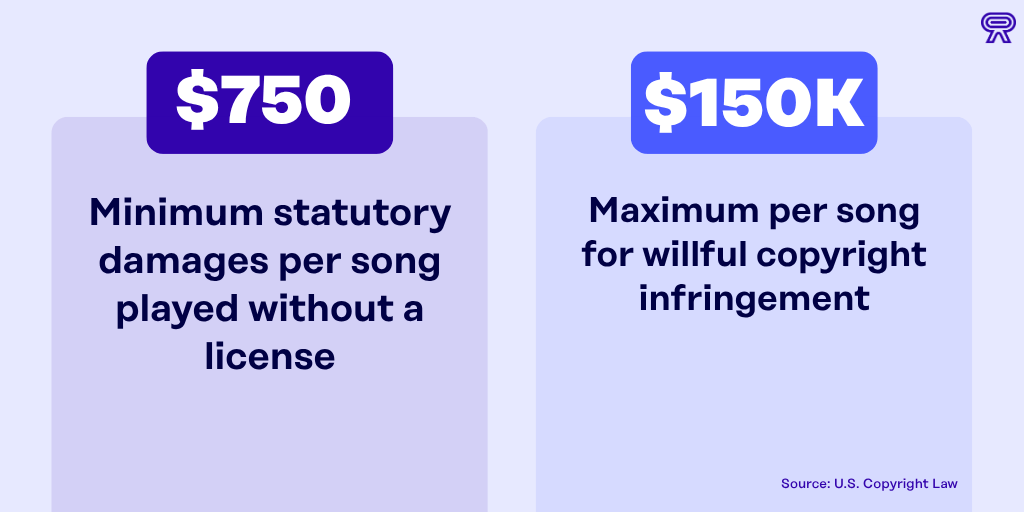
Copyright infringement carries real financial consequences. Statutory damages start at $750 per song played without a license in the U.S., and willful infringement can result in damages of up to $150,000 per song.
Those figures multiply quickly across a typical music program containing many different songs. Businesses found in violation may also potentially be responsible for the PRO's legal fees on top of any damages awarded.
Lack of awareness around business music licensing will not, unfortunately, be recognized as a valid defense to copyright infringement. PROs are well-resourced and actively pursue claims of copyright violations against any and all unlicensed users of music they can identify. Beyond the financial risk, the time and disruption of a legal dispute carry their own costs to a business.
Further, proper licensing protects your business and ensures the artists whose music contributes to your environment are fairly compensated for their work.
Industry-Specific Considerations
The fundamental licensing requirements in this guide apply across all commercial venues in the U.S. Certain business types have additional nuances worth understanding.
Restaurants and bars that host live music, DJs, or karaoke need licensing beyond standard background music coverage. Each use requires its own license tier, and factors like cover charges and square footage can affect fees.
Fitness studios should note that Rockbot's standard service covers general ambient background use in your facility, but music used in instructor-led fitness classes requires separate licensing obtained directly from the PROs.
Retail stores playing recorded background music typically have more straightforward needs, with square footage as the primary cost variable.
Entertainment-focused venues that charge admission (like bowling alleys) may face additional complexity. We recommend consulting your industry trade organization for guidance specific to your venue type.
Hotels, medical and dental offices, salons, and any other business where music plays in public-facing spaces all require licensing coverage.
The common thread: if music is playing out loud where customers or the public are present, licensing is required.
How Businesses Can Address PRO Licensing
When you use Rockbot Music in the U.S., we cover all your licensing requirements, including ASCAP, BMI, SESAC, and GMR – so you can focus on running your business, not managing paperwork. We handle renewals, fees, and the administrative work that comes with maintaining four separate licenses, all included in your Rockbot subscription.
One thing to keep in mind: Rockbot's licensing does not cover music from DJs, live musicians, karaoke, radio, television, consumer streaming services, or personal devices. If you use music through any of those sources, you'll need to obtain licenses directly from the PROs – and Rockbot's team can point you toward the right resources.
Beyond licensing, Rockbot Music gives you access to millions of fully licensed songs across every genre, with curated playlists, smart scheduling by daypart or season, and real-time control from the Rockbot Dashboard or mobile app – whether you're managing one location or hundreds.
Ready to simplify your music licensing? Check out our free 7-day trial.
This article provides general guidance on music licensing with respect to Rockbot and does not constitute legal advice. Music copyright is a highly complex area of entertainment law. Please direct any specific questions about your own business's use of music to a knowledgeable attorney or music rights consultant.